

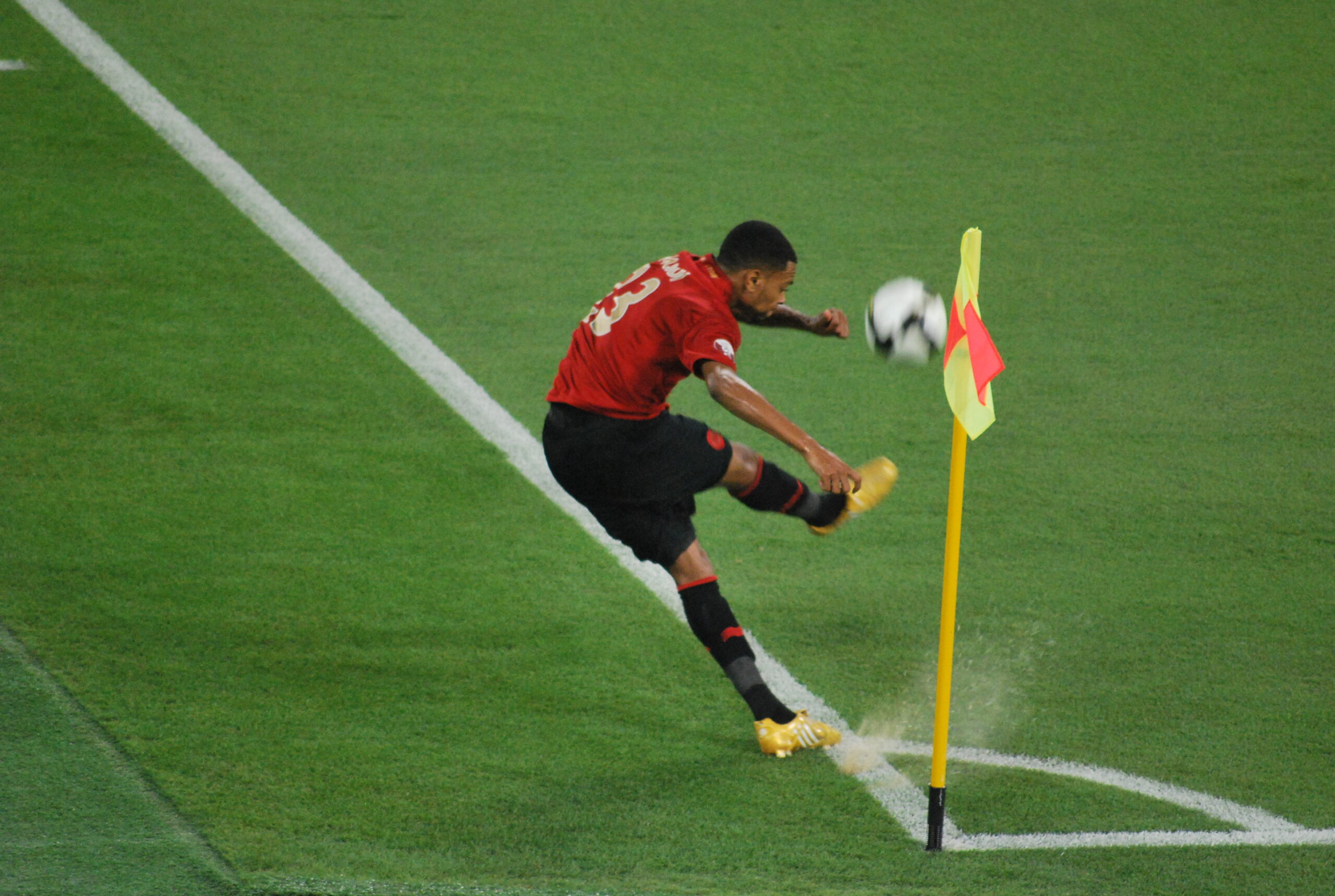

Strategies, Data and Guiding Principles from Dead-Ball Situations
Set-piece strategies, data and guiding principles are today an increasingly decisive factor in modern football. In this article, drawing on the teachings of coach Gianni Vio during the AIAC Master Programme (delivered in collaboration with FIGC Technical Department instructors and YouCoach) and integrating my direct experience as a course participant, analyst and assistant coach, I examine dead-ball situations from an offensive perspective. For reasons of conciseness, the objective is to isolate and explore the macro-structural concepts, deferring the analysis of the defensive phase to a dedicated follow-up piece.
The dead ball is no longer a minor detail, it is a dramatically incisive element in determining the final result. Statistics point to a steady increase, of 5–8% per year from 2023 onwards, in the share of goals scored from set pieces relative to total goals. Currently, certain elite sides are capable of generating almost 40% of their total goals from dead-ball schemes and developments.
The dead ball is no longer a minor detail, it is a dramatically incisive element in determining the final result.
The Starting Point: Using the Laws of the Game as a Strategic Tool
The first axiom transmitted by coach Gianni Vio establishes that the architecture of every set-piece routine must begin with a study of the Laws of the Game. The rules are not to be read as a constraint, but as an instrument to be known and actively used to generate concrete danger for opponents.
The rules are not to be read as a constraint, but as an instrument to be known and actively used to generate concrete danger for opponents.
The 9.15-Metre Distance
This regulatory measure should be read as the space required to clear the ball’s trajectory, enabling the taker to strike with maximum quality. Data demonstrate, for instance, that every short pass executed during a corner routine reduces by 20% the theoretical probability of threatening the opposition, unless the specific characteristics of our players make close combination play preferable to a direct delivery into the penalty area.
The Offside Rule
As is well known, offside is not active on the first delivery of a corner kick, a throw-in, or a goal kick. This shapes the strategic organisation of play, enabling specific danger zones to be created. This rule can be exploited to obstruct the goalkeeper and his sightlines; alternatively, to direct the first delivery from a corner straight towards the goal-line, thereby making a larger area of the pitch available for subsequent play, particularly where a flick-on or lay-off is preferred to an immediate cross into the heart of the penalty area.
The “Dictatorship” of Timing and the Moment of Execution
A further pillar of the methodological approach is an awareness of flow time control. From a dead ball, we decide when to move the ball and determine the first move. Dictating the tempo of execution forces the goalkeeper and the opposition defensive line into a progressive psycho-physical attrition (wearing down the goalkeeper’s waiting posture and concentration) while keeping our attackers in complete emotional control before they attack the ball’s trajectory. Coach Vio emphasises the possibility of one additional movement compared to open play, which grants us one extra unit of time.
Philosophical Vision and Core Principles
The underlying philosophy rests on pragmatic concepts relating to the cognitive management of the player and tactical prevention:
- Rigid Task Assignment: A higher cognitive load carries an elevated risk of hesitation, the primary cause of on-field error. The mind struggles to process simultaneous inputs.
- Always a Proactive Attitude: The ball must always be attacked with determination. A passive or waiting attitude is the principal factor that leads to conceding goals or wasting favourable transitions.
- Psychological Value: Scoring from a dead-ball situation validates the collective work carried out during the week and creates a devastating emotional connection, inflicting a severe psychological blow on the opposition.
- Second-Ball Management and Prevention: In the event of a poor trajectory or a clearance, the ball should be directed immediately out of play (especially from high-risk zones) to neutralise the opposition’s counter-attack transitions.
The Seven Training Categories
The universe of dead-ball situations is divided into seven operational macro-families, each with its own inherent logic and specific training dynamics:
- Offensive Corners (and their defensive counterparts)
- Close Lateral Free Kicks (and defensive counterparts
- Central Free Kicks within 30 metres
- Offensive Throw-Ins (with a long-throw specialist)
- Long-Range Free Kicks (second-ball cross development)
- Penalty Kicks
- Goal Kicks and Low Free Kicks (build-up and ball circulation)
Statistical Evidence from Elite Competitions
What do real data say about these categories? A recent statistical analysis conducted on the English Premier League (2025–26 Season) reveals scenarios of considerable strategic interest.
Goals originating from throw-in developments have surpassed the 10% threshold of total set-piece goals, recording a higher volume than lateral and central free kicks taken individually. Only when combined do central and lateral free kicks marginally exceed the throw-in figure. At the same time, a significant decline in goals scored directly from free kicks has been recorded in recent years.
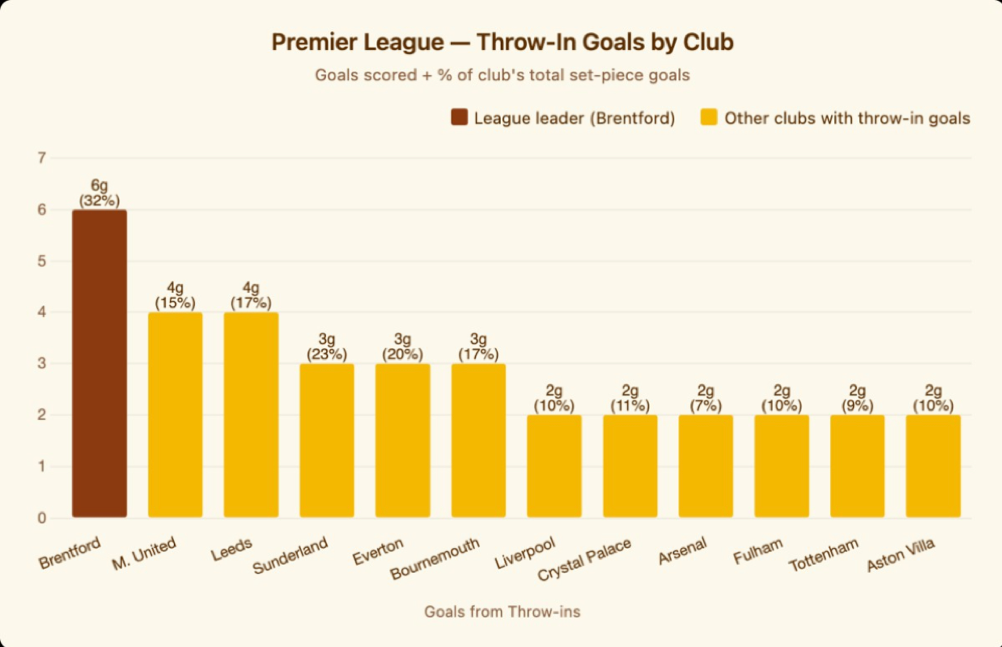
The global benchmark in this category is Brentford, a club that has standardised an extraordinary level of threat through the use of long throws. recording 6 goals, equal to 32% of their total dead-ball output. A series of small strategic adjustments can dramatically increase effectiveness in these situations:
- A throw-in in proximity to the opposition penalty area should be understood and codified as a genuine attacking routine, not a simple restart. If the squad has a long-throw specialist, this asset must be exploited systematically.
- Long-range free kicks follow the same principle: even if the delivery occurs at a considerable distance from goal, the situation must be worked meticulously as an opportunity to penetrate the opposition penalty area.
The Corner: The “King” of the Dead Ball
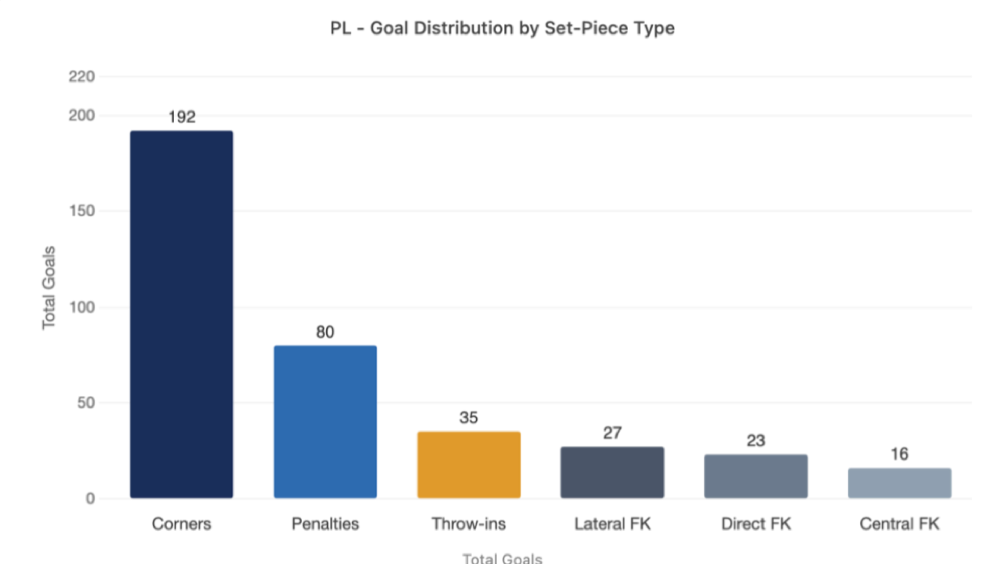
When analysing aggregate dead-ball goal volumes, the corner kick emerges as the absolute sovereign of the category. The data confirm that 55–60% of total dead-ball goals originate from corner kicks. As the central nucleus of offensive dead-ball production, the methodological consequence is clear: the majority of the weekly hours dedicated to set pieces must be invested in the study and training of corners. Chart 2 below shows total Premier League goals this season broken down by dead-ball type, with 35 goals originating from throw-ins.
Strategy and Variable Management at Corner Kicks
The cardinal principle consists of driving the opposition defensive structure into a state of planned confusion. This confusion must never coincide with any internal disorganisation on our part: the objective is to force defenders into forced decisions within fractions of a second, dismantling their certainties.
The attacking scheme aims to destabilise the individual defensive fundamentals of the marking player, who (by posture and positioning) must simultaneously see the ball, the goal, and the opponent. If we disrupt this visual triangle, we gain an immediate advantage.
Coach Gianni Vio identifies 4 Fundamental Variables:
| Variable | Description |
|---|---|
| Number of Players | Quantify how many and which players to deploy in the attacking phase relative to the opposition’s defensive positioning across different zones. |
| Starting Positions | Strictly defined starting and arrival positions; within the journey between these two points, the player retains freedom to interpret his run. |
| Shape | The geometric arrangement of the attacking block (the formation adopted before delivery). |
| Movements | Coordinated movements create disruption and distraction. The codified movement pattern follows a linear sequence: occupy a position, vacate it, and immediately reoccupy it (using systematic blocks and decoy runs). |
Decision Speed and Reaction Times
The average human reaction time to sudden stimuli is approximately 0.5 seconds. This factor can be manipulated to our advantage. On direct free kicks, for instance, positioning a wall of bodies that obscures the ball and the precise moment of departure delays the goalkeeper’s reading, making a save physically impossible. Similarly, at corner kicks, applying tight pressure on the opposition goalkeeper impairs his capacity and timing to come off his line.
Technical and Structural Analysis of Corners
Beyond adherence to regulatory principles, field experience and the coach’s teachings identify the highest-efficacy factors:
- The Near Post: Driven deliveries towards the near post, when attacked with the right timing, generate a reduced defensive reaction window, multiplying the probability of winning deflections or provoking own goals.
- Inswinging Trajectories: Inswing deliveries historically offer a higher success rate than outswing ones. A direct corner attempt on goal is also a major threat, the goalkeeper finds a ball travelling vertically more difficult to read than a diagonal delivery, as in a crossed lateral free kick.
- Profiling the Attackers and Ongoing Dialogue: The technical sensitivity of the taker is crucial but must be integrated with continuous dialogue with the headers. Individual profiles must be mapped to understand which zones of the goal each of our players prefers to attack, defining precise insertion-timing profiles for each, to free up the most dangerous players and improve the quality of the attack.
Adapting to the Opposition’s Defensive System
| Defensive System | Deficit / Vulnerability | Offensive Strategy to Adopt |
|---|---|---|
| Man-to-Man Marking | Opponents can be moved out of position | Exploit blocks and crossover movements to drag defenders away, pre-clearing the chosen attacking zones. |
| Zonal Marking | Overloads possible; free players can be created | Create numerical and positional overloads in restricted areas (e.g. sending multiple runners to attack the near post simultaneously). |
| Mixed System | Key players can be freed up | Create situations to isolate key players and exploit the gaps between zonal and man-marking cover. |
Second Balls and Transition
Statistical analysis reveals that 70% of loose second balls fall within a radius of 18–30 metres from goal, concentrating around the penalty arc and inside the half-spaces. The preventive positioning of our midfielders and defenders in this area of the pitch is fundamental, both for an immediate shot on goal and for the early interception of negative transitions.
Equally vital is the organisation of the positive transition on corners conceded. When the opposition takes a corner, they are momentarily structurally disorganised in the event of possession loss. The team that wins the ball has a window of approximately 8 seconds to strike before the opposition can reorganise their defensive shape. A pre-designed counter-attack must be structured: who to play to, which channel or flank to use, and with how many players to attack.
In the top leagues, 1 goal in every 7 arises from a transition originating from a dead-ball situation. This mechanism cannot be improvised: it demands a mental attitude that is simultaneously protective and aggressively offensive, even when out of possession.
A parallel chapter concerns the goal kick, where the goalkeeper provides a constant numerical advantage in the initial build-up phase. The modern goalkeeper must be intensively trained in managing all types of distribution (short, medium-long, long) and must be able to read the game, interpret different pressing structures, and adapt his decision-making to the squad’s structural characteristics and the club’s playing philosophy, a theme rich enough to merit an article of its own.
Training Methodology: How Much and How to Work
The success of any set-piece strategy is built 90% during the weekly training sessions. The fundamental prerequisite is an analytical study of the opposition across a minimum sample of 4 recent matches, in order to map and predict their defensive or offensive approach. If statistical evidence shows that over 30% of a team’s goals derive from dead-ball situations, the methodological logic dictates that at least 30% of total field-training time must be dedicated to set pieces. Consistently and productively training dead-ball situations is equivalent to having an additional striker capable of contributing over 15 goals per season.
Consistently and productively training dead-ball situations is equivalent to having an additional striker capable of contributing over 15 goals per season.
Isolated Training for the Taker
The only technical element that, in coach Vio’s view, can and must be isolated from the collective context is the designated delivery player. To refine his ballistic sensitivity and the millimetre precision of his trajectories, the taker must follow a dedicated repetition programme: 20 minutes per session, 3 sessions per week, performing between 50 and 80 total repetitions per microcycle, varying intensity, angle of approach and trajectory. If the taker is the trigger of the action, he is obliged to exercise his kicking foot constantly.
The 3 Operational Phases of Collective Training (11 v 11)
The staff’s methodological pathway begins with in-depth video analysis examining: the opposition goalkeeper’s tendencies, the nature of the defensive line, individual anthropometric characteristics and structural weaknesses, and the attitudinal profiles of opponents. Following the video session with the squad, tactical boards are drawn up and targeted group meetings are held.
| Phase | Description | Intensity |
|---|---|---|
| 1. Silent Phase | Execution of routines and movements with no defensive opposition. Primary objective: knowledge and awareness of running timings and spatial synchronisations | Medium / Low |
| 2. Live Phase | Execution of the same tactical situations against an active defence opposing at full match intensity. | Match intensity |
| 3. Closed Phase | Recreation of the specific situation within a real match context or themed game | Full / Competitive |
In each of these steps, the support of training video analysis is indispensable for correcting and discussing errors directly with the group. It is preferable to use mixed groups, involving all squad members in the flow of play to avoid drops in concentration. This work should be tested both under conditions of complete mental freshness and induced physical fatigue, not confined exclusively to the end of the session. A themed game focused, for example, on corners, lasting 20 minutes, heightens internal competition and guarantees higher attentional and emotional engagement.
Isolated Case Study: Experience at Marsaxlokk FC
The validity of this theoretical and methodological approach finds objective confirmation in the data recorded during my most recent professional experience on the bench of Marsaxlokk FC, alongside head coach Vincenzo Potenza.
Our journey did not diverge significantly from the approach described here: video analysis, scheme design, themed games with mixed squads (each adjusted according to the day of the week with greater or lesser focus on a specific situation) making the players the true owners of the dead-ball dynamics. The guiding principle was player orientation: by giving players greater responsibility and awareness within each dynamic, and without having relied on individual goal-scoring references, we achieved a collective impact on set pieces with goals and assists distributed across multiple takers. This collective output was a fundamental element that took us to the podium as league runners-up, qualifying for the UEFA Conference League, having lost the championship final at the 92nd minute.
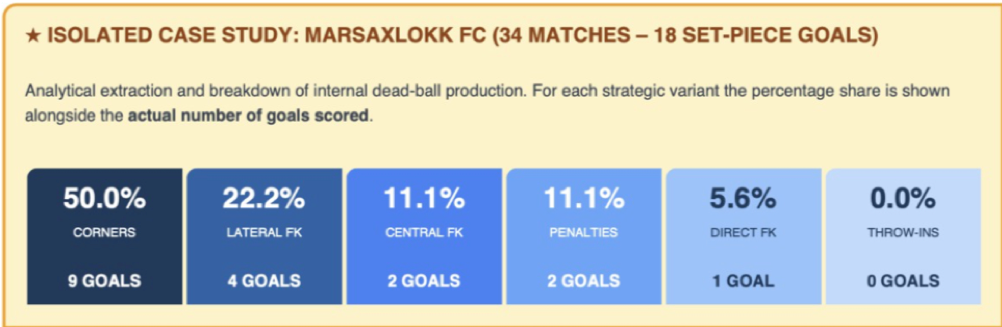
Out of 45 total goals scored by the squad across 34 official matches, 18 goals (40% of the total) originated from dead-ball situations. The analytical breakdown of our output is shown below.
Conclusions: The Three Pillars to Take Away
In summary, the study pathway and field practice impose the assimilation of three fundamental concepts for any coaching staff that aspires to excel in set-piece management:
| Specialists | It is necessary to develop ultra-specific profiles within the squad, from the long-throw specialist to the set-piece taker for direct or indirect free kicks, through to the ball-playing goalkeeper. Modern football demands category specialists, moving beyond the figure of the all-round player. |
| Signals | The effectiveness of play lies in the use of codified options. The use of code words and precise signals allows the attacking block to vary its strategic choice in real time according to the opposition’s positioning. Nothing is left to chance or improvisation: scientific organisation is the only key to dominating the chaos inside the penalty area. |
| Different Categories | Throw-ins, free kicks and goal-kick management should not be interpreted as simple interruptions of play. They are dead-ball situations in every respect, governed by their own inherent logic, specific geometries and a defined tactical identity. |