

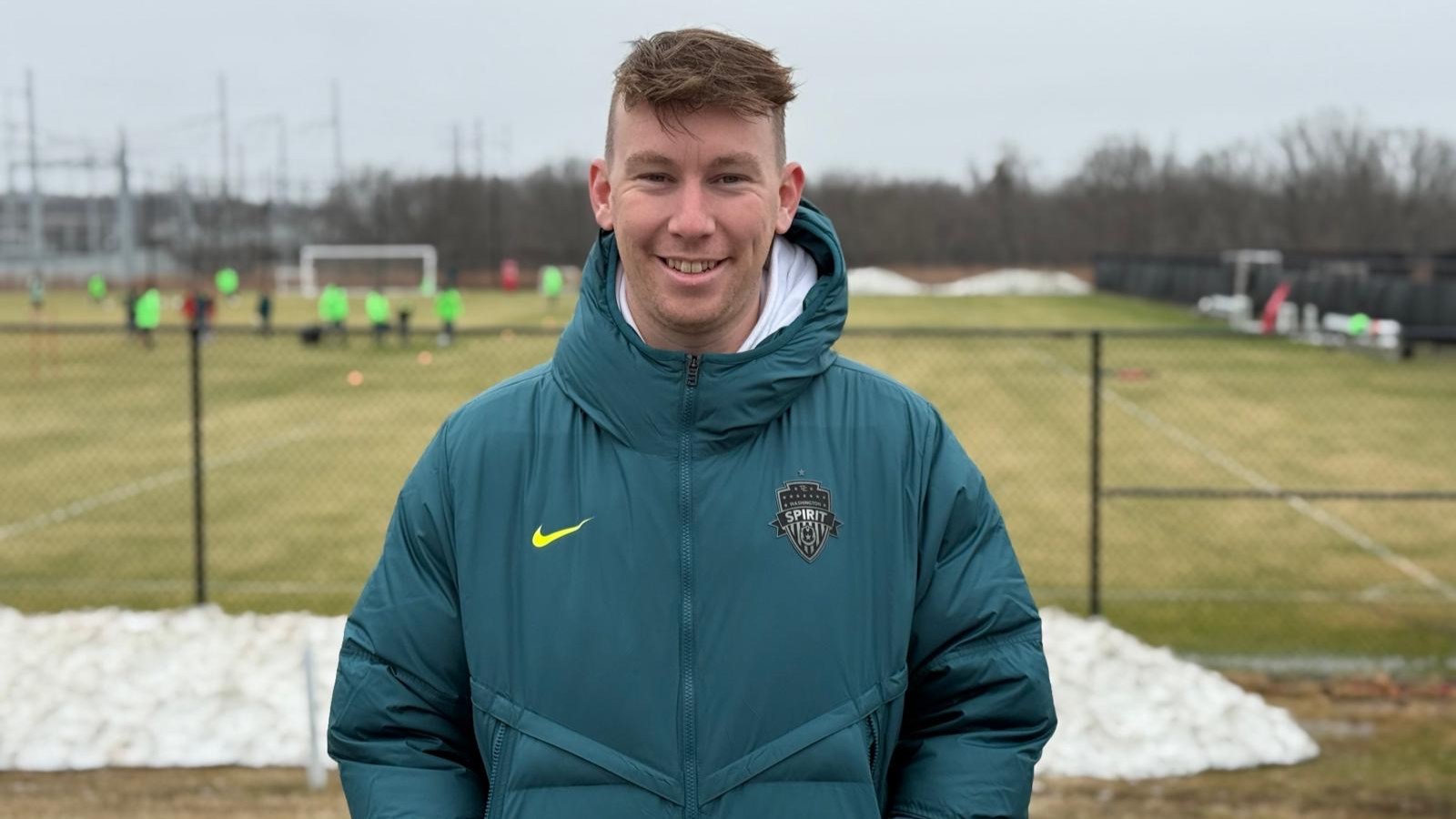
Role: Sporting Director, Washington Spirit
Specialisation: Analytics, Recruitment and Sporting Strategy
Experience: NWSL, NCAA, English academies and federation environments
Focus Areas: Data-informed decision making, roster construction and long term sporting planning
Biography
In modern football leadership, competitive advantage increasingly lies in how effectively clubs translate information into decisions. As data, analytics and global scouting networks reshape the way teams are built, sporting leaders must balance quantitative insight with football expertise and long term strategic planning.
James Hocken represents a new generation of decision makers operating at this intersection. As Sporting Director of Washington Spirit, he oversees recruitment, roster construction and long term sporting strategy within the complex regulatory framework of the NWSL. With a background spanning analytics, coaching environments, international development structures and professional football operations, his work reflects the growing influence of data informed decision making in elite women’s football.
Key Insights
- How data and analytics are shaping modern sporting director decision making.
- Why proactive squad planning is essential in a salary cap environment.
- How analytics and coaching expertise can complement each other in football leadership.
Our Exclusive Interview with James Hocken
As Sporting Director at Washington Spirit, how do you define the club’s game model and ensure it is consistently applied across recruitment, development and staffing?
Firstly, it is important to recognise that the lens of a club’s game model is not the same as that of a head coach. For us, the club’s game model represents a broader strategic framework that defines how we want to play, how we want to recruit and how we want to develop players. It is clearly documented and defined, but it operates at a different level of detail compared to the coaching staff. For example, the club does not prescribe formations or tactical systems.
Every coach has their own tactical preferences, and it would be both unfair and unproductive to force coaches to conform to a rigid way of coaching. Just like players, coaches need the freedom to express themselves.
That said, the club’s game model and the coach’s game model must be aligned. Our model outlines overarching principles for the different moments of the game. These principles are shaped by our understanding of what is required to be successful in the NWSL, as well as the stylistic vision preferred by our ownership group.
Crucially, these principles are measurable. We use them to create key performance indicators that allow us to evaluate team performance and also help identify potential coaches and players who fit our approach.
The NWSL operates under strict roster and salary cap regulations. What principles guide your succession planning across multiple transfer windows?
Operating within these regulations is both extremely demanding and very exciting. Our objective is to build a team that can compete for championships year after year rather than pursuing a single all or nothing season.
We have invested heavily in building a strong analytics department that helps us identify players globally who can contribute to a sustainably successful team. Our investment in scouting and analytics gives us the confidence to take calculated risks on players that other clubs may not yet feel comfortable pursuing. This allows us to build a squad with both quality and depth.
From there, every decision must take the future into account. The salary cap environment makes reactive decision making extremely difficult if you want to remain competitive over time. As a result, we try to be proactive in how we invest in the future.
Football is unpredictable, but if we can prepare for as many potential outcomes as possible in advance, we spend less time reacting to problems. Ideally, the challenges we face today have already been addressed through decisions made in the past.
Football is unpredictable, but if we can prepare for as many potential outcomes as possible in advance, we spend less time reacting to problems.
You moved from Head of Analytics into a Sporting Director role. How has this background changed the way you approach recruitment and contract decisions?
Coming into this role with a background in analytics has allowed me to advocate strongly for the role that data can play in leadership decisions, particularly in areas where data has traditionally been less present.
I believe it has helped our organisation become more data informed. At the same time, the role has exposed me to many situations where data alone cannot provide the answer.
One thing I am particularly proud of is seeing the proof of concept for how analytics can support recruitment processes. I always believed in its potential, but seeing it operate successfully in practice has been very rewarding.
The biggest learning curve for me has been the importance of relationships. In this position I spend a great deal of time communicating with agents and with recruitment and leadership staff across different clubs. That relational aspect of the role has become a very significant part of the work.
Washington Spirit has embedded analytics deeply into sporting operations. How do you balance data input with coaching expertise and football judgement?
I believe the reason the so called data versus coaching debate has gained so much traction is because there have been too many examples of poor analytics being introduced into football environments.
The problem is not analytics itself but the quality of the analytics being used. Just as there are different levels of coaching quality, there are also different levels of analytical quality.
Bad analytics often result from ignoring context or from misunderstanding and misapplying metrics when making decisions. Frequently this involves relying on overly simple metrics that offer very little value in actually understanding the phenomenon they are supposed to measure.
Having seen poor analytics in action and then comparing that with the work our analytics team has done to understand context and model the variables that influence performance, I am very confident that analytics exists on a spectrum of quality.
At the same time, the insights provided by data and by coaching expertise are fundamentally different and should complement one another. Data can provide information that no individual within the organisation might otherwise possess. It can challenge biases and improve the efficiency of processes.
However, ignoring the insights that come from coaching experience and other forms of expertise would be equally wasteful. The most effective approach is to combine these perspectives. When you listen to the different viewpoints across the organisation and complement them with data informed insights, you create the most complete picture possible.
The most effective approach is to combine these perspectives.
You have led teams across analytics, recruitment and coaching environments. What is your approach to aligning interdisciplinary staff around shared performance objectives?
My approach is largely shaped by trying to replicate the best leadership examples I have experienced.
I was very fortunate to spend many years working under Mark Krikorian, who I believe is one of the greatest leaders in women’s soccer. Anyone who has worked with him would likely say the same.
I also had the opportunity to work with Jonathan Garbar, whose leadership qualities are exceptional. While the college environment is very different from the professional game, his ability to understand and manage the psychological dimension of performance was something I learned a great deal from.
Leadership is still an area I continue to develop. My priority is to ensure that the people I work with feel supported, have the freedom to express themselves creatively, feel ownership of their responsibilities and are recognised for their contributions.
If people enjoy coming to work every day, aligning them around shared objectives becomes the easier part.
You have worked across NCAA, NWSL, English academies and a federation environment. What structural differences stand out most in talent development across these systems?
It is difficult to compare these systems directly because my experience spans different contexts including men’s and women’s football, youth and professional levels, and both England and the United States.
However, one consistent factor in successful development environments is strategic planning around when players interact with different staff members and how those interactions are structured.
Periodising cognitive load in the same way that physical load is periodised is extremely important. Ensuring that the time spent with athletes is targeted and effective helps maximise their development.
Another key factor is the diversity of expertise surrounding the athlete. Having multiple perspectives and areas of expertise involved in understanding a player’s stage of development allows for more comprehensive development plans.
This was something that particularly impressed me during my time working with The FA youth national teams.
Technology and process design are central to your leadership profile. How do you decide which tools genuinely improve decision making?
The starting point is always extensive research. Procurement decisions involve many factors, but one of the most valuable steps is speaking with people who use the tools on a daily basis and can provide an honest assessment rather than a sales pitch.
Every staff member will have preferences based on what they feel comfortable using, and that is an important consideration.
At the same time, I always try to think about the long term question. What decisions will we be happy about three years from now? That perspective often helps guide which tools and processes are worth investing in.
Looking ahead, how do you see the Sporting Director role evolving as women’s football continues to professionalise?
The role of a Sporting Director already varies significantly from club to club within the women’s game. We are starting to see some organisations distribute those responsibilities across several roles.
In the NWSL, many clubs already operate with both a General Manager and a Sporting Director, alongside a CEO or President. That structure differs from many other parts of the world.
Looking ahead, I expect the Sporting Director role to increasingly embrace the use of analytics in decision making. We have already seen this trend develop across American sports over the past decade, and women’s football is likely to follow a similar trajectory.
The extent to which analytics contributes to success will depend heavily on the quality of the models and how they are implemented. However, I do believe that organisations unwilling to engage with data at all will find it increasingly difficult to remain competitive.
FAQ
Who is James Hocken?
James Hocken is the Sporting Director of Washington Spirit in the NWSL, overseeing recruitment, roster construction and long term sporting strategy.
What is James Hocken known for in football leadership?
He is known for integrating analytics, data informed decision making and traditional football expertise into modern sporting operations.
How is analytics shaping women’s football leadership?
Analytics increasingly supports recruitment, performance evaluation and strategic planning, helping clubs make more informed long term decisions.