

Across 47 Member Associations, women’s football in Asia is progressing under vastly different structural, cultural, and economic conditions. Steering that complexity requires more than programme coordination. It demands strategic clarity, contextual sensitivity, and long-term governance discipline.
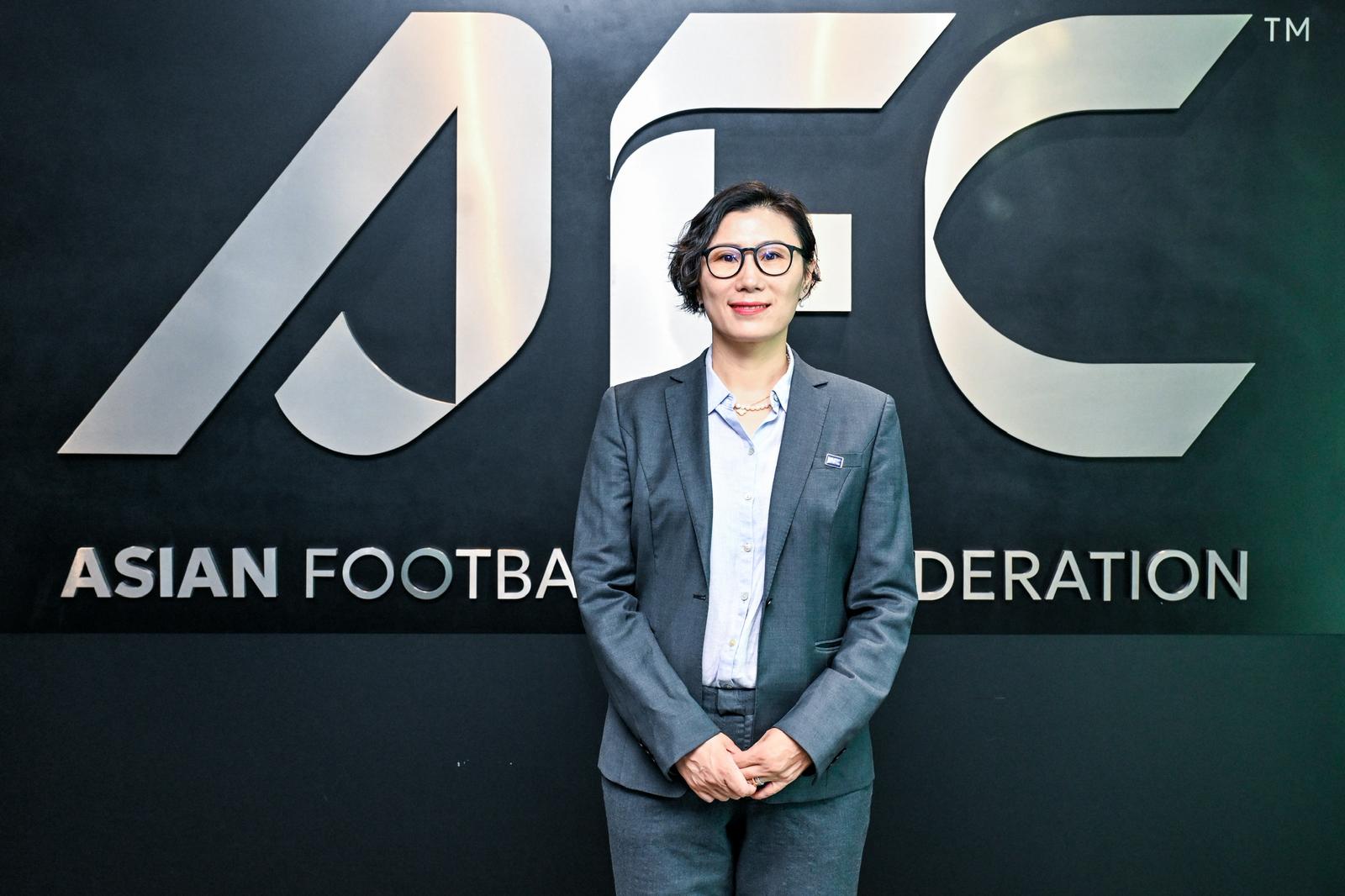
Bai Lili serves as Head of Women’s Football at the Asian Football Confederation, where she oversees the technical direction and structural development of the women’s game across the continent. With experience as an elite player, national federation leader in China, and now a continental decision-maker, she operates at the intersection of policy design, coach education reform, competition architecture, and sustainable pathway development. In this conversation, she outlines the strategic priorities shaping women’s football across Asia and the indicators she considers essential for measuring genuine long-term progress.
Our exclusive interview with Bai Lili
In your current role as Head of Women’s Football within the AFC Technical Division, how do you define the strategic scope of your responsibility across 47 Member Associations, and how do you prioritise impact at such a scale?
Across 47 Member Associations, our focus is on establishing the conditions for sustainable progress. The strategic scope of the role spans governance guidance, programme frameworks, coach education standards, competition structures, and targeted technical support, all adapted to different levels of development across Asia.
Rather than imposing uniform solutions, we always seek tailored approaches that allow flexibility for MAs to develop the game within their own contexts, while still aligning with shared technical priorities.
Rather than imposing uniform solutions, we always seek tailored approaches that allow flexibility for MAs to develop the game within their own contexts, while still aligning with shared technical priorities.
Among the tailored services the Confederation provides, the AFC Women’s Assistance Programme plays a key role. Through regular visits, we work closely with MAs to assess their specific needs and provide guidance aligned with the Women’s Football Strategic Plan, identifying the most suitable and sustainable development pathways.
We also place strong emphasis on visibility and engagement. Initiatives such as the AFC Women’s Football Day, celebrated in conjunction with International Women’s Day, allow each Member Association to mark the occasion in a way that reflects its local context. In addition, the AFC’s It’s My Game campaign, which has a reach of millions, recognises and celebrates the growing contribution of women across Asian football, highlighting success stories from every Regional Association and at all levels of the game.
What principles guide your decision-making when aligning technical standards with highly diverse national contexts across Asia?
When working across Asia, it is important to recognise that no two MAs operate in the same environment. While the AFC establishes clear technical benchmarks, particularly in coach education, youth development, and competition structures, how those standards are applied must reflect local realities such as infrastructure, culture, geography, and available resources.
For me, decision-making is always grounded in realism and long-term sustainability. Development cannot be driven by short-term comparisons or external pressure. Our responsibility is to support steady progression and ensure that each Member Association can move forward at a pace that is both ambitious and achievable.
This also requires strong internal collaboration. Close alignment with our Member Associations Division and the Competitions and Football Events Division allows us to take a more holistic view of development. By understanding where each Member Association stands, we can identify practical next steps that strengthen technical credibility without overlooking local constraints.
How has your experience shaped your approach to building sustainable pathways between grassroots, elite development, and coach education structures?
Having worked across grassroots, youth development, elite football and coach education, I see these areas as one connected ecosystem rather than separate pillars. Sustainable pathways only exist when coaches, competitions and development environments are aligned at every stage.
Sustainable pathways only exist when coaches, competitions and development environments are aligned at every stage.
Coach education, in particular, is the connective tissue of development. Well-educated coaches create better environments at every level, from schools to elite academies. At the AFC, this understanding translates into prioritising coach education reform, tutor development, and alignment between youth competitions, academies, and national team structures.
Your background combines elite playing experience, national team exposure, and senior technical leadership. How does this dual perspective influence how you evaluate development programmes and technical policies today?
Having lived the game as a player and now shaping it from an administrative perspective allows me to evaluate programmes through both a technical and human lens. On paper, a programme may meet all structural requirements, but it is equally important to assess how it impacts the daily reality of players and coaches on the ground.
My playing experience helps me determine whether policies genuinely improve training quality, competitive exposure, and player welfare. At the same time, my administrative responsibilities require consideration of scalability, governance, and long-term sustainability. Balancing these perspectives ensures that technical policies are not only sound in theory, but meaningful and practical in implementation.
Coach education is a recurring pillar throughout your career, from instructor roles to continental programme delivery. How do you assess the current maturity of women’s football coach education in Asia, and where do you see the most urgent structural gaps?
Coach education remains one of the most critical elements in football development, but progress across Asia has been uneven and not all MAs have advanced at the same pace, with limited female representation at elite coaching levels being one example.
To help address this, the AFC joined forces with the Japan Football Association to introduce a Women’s Pro Diploma Course aimed at increasing the number of female coaches holding professional licences.
However, certification alone is not enough. The most urgent gaps relate to retention, mentoring, and practical deployment. Many female coaches complete their qualifications but lack consistent opportunities to coach at appropriate levels.
Strengthening mentoring systems, linking coach education more closely with women’s competitions, and creating clearer professional pathways are critical next steps. Coach education must support long-term career development, with MAs playing a key role in providing meaningful, real-world opportunities.
Looking back at your transition from national federation roles in China to a continental leadership position at AFC, what shifts in leadership mindset were required to operate effectively at confederation level?
The most significant shift was moving from direct implementation to strategic influence. At the national level, familiarity with the culture and operating context allows for more immediate alignment and execution. At the confederation level, progress is achieved less through leading from the front and more through enabling others to succeed.
This transition required greater patience, stronger listening skills, and a broader, culturally informed perspective. Balancing diverse and sometimes competing regional priorities became essential, as did evaluating success through collective advancement rather than individual outcomes. Leadership at the confederation level is ultimately about building trust, maintaining consistency, and empowering MAs to take ownership of their development journeys.
Based on your long-term involvement in women’s football as a player, coach, and administrator, what indicators do you personally use to judge whether women’s football development efforts are genuinely progressing rather than simply expanding in volume?
For me, genuine progress is reflected in quality and continuity. I look at whether girls are staying in the game longer, whether coaching quality is reflected in the game, and whether national pathways are producing players who can transition successfully to higher levels.
Other key indicators include the professionalism of domestic competitions, the presence of qualified female coaches in meaningful roles, and the ability of MAs to independently sustain programmes. Growth in numbers is important, but true development is evident when systems become stable, credible, and capable of producing long-term impact.