
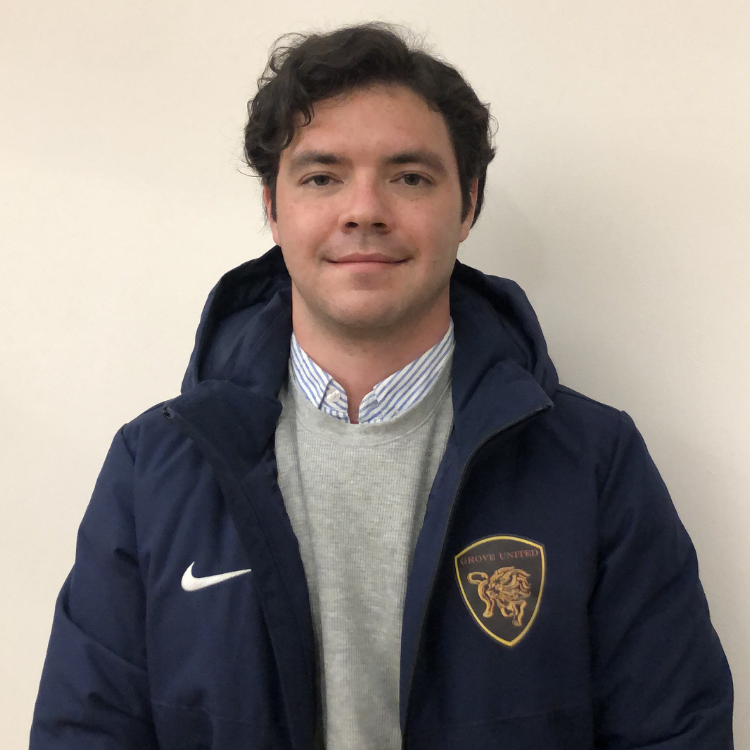
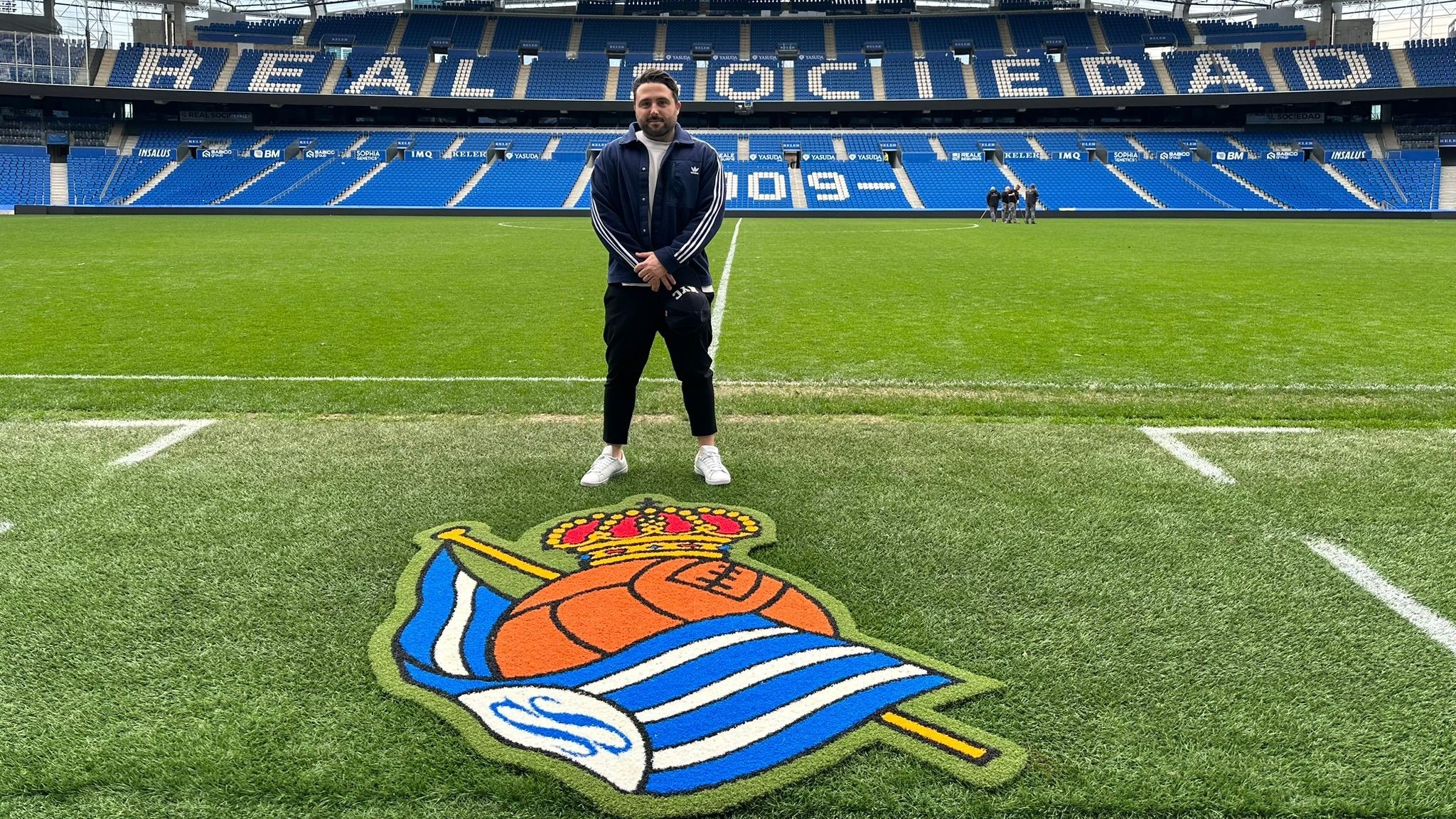
France to Real Sociedad: the journey of Sacha Esteves, a scout specialized in young talent
For three seasons, Sacha Esteves held a key role at Real Sociedad as the person responsible for scouting young French talent. Tasked with analyzing age groups ranging from U14 to reserve teams, he contributed to identifying profiles capable of integrating the academy of a club renowned for its high standards, stability, and the coherence of its sporting project.
In this role, he traveled throughout France, with a particular focus on the Paris region, one of the country’s richest talent pools. His mission was to identify atypical profiles able to bring real added value to Real Sociedad’s playing model. Contrary to common belief, recruitment was not limited to players with a purely “Spanish” style, but rather to complementary profiles, especially in terms of speed, power, and verticality.
His mission was to identify atypical profiles able to bring real added value to Real Sociedad’s playing model.
To cover as much ground as possible, he relied on a rigorous methodology combining targeted live scouting with video analysis through specialized platforms such as Wyscout, Hudl, and Eyeball, enabling him to develop a global and structured view of the French talent pool.
His background as a coach, holding a UEFA B coaching license, combined with his experiences as a sporting advisor, within player agencies, and at CarriereFoot, allowed him to refine his eye, strengthen his understanding of the game, and build a strong nationwide network. This dual scouting and coaching perspective enhances his ability to analyze both the player and the person. Operating daily in an international context, he works fluently in French, Spanish, and English, with working knowledge of Italian.
His time at Real Sociedad remains a foundational chapter in his career. There, he discovered a united institution driven by a shared vision, where youth development emphasizes relationship with the ball, game intelligence, and the player’s overall growth, beyond purely athletic criteria.
Sacha Esteves continues his journey with the same passion and high standards, driven by a desire to keep learning, to discover other footballing cultures, and to put his expertise at the service of an ambitious project.
His time at Real Sociedad remains a foundational chapter in his career.
Our exclusive interview with Sacha Esteves
You spent three seasons at Real Sociedad. What were your missions and responsibilities?
During those three seasons, I was in charge of the French youth market. My role was to scout age groups ranging from U14 up to reserve teams in France. From time to time, for certain tournaments or youth national team events, I could also travel abroad. Like most scouts, my main mission was to identify the profiles most likely to meet the club’s needs at a given moment and potentially join the academy. There is a huge amount of young talent in Paris.
What criteria do you prioritize when bringing a young French player to Spain, and how do you try to cover as much ground as possible?
Île-de-France is an incredible talent pool, at any match, even in the lower divisions of an age group, you can find one or several surprises. The criteria were somewhat the opposite of what most people think about Spanish football. There’s a common belief that Spanish clubs only look for players with a “Spanish” playing style, but in reality, it’s quite the opposite. Why bring in a player who is similar to 98% of those already there? My mission was precisely to identify these “atypical” players who could bring real added value to the squad they would join.
The key qualities I was looking for were speed, power, and verticality, traits that are harder to find locally, where profiles tend to be more technical, ball-oriented players rather than space-oriented ones.
To try to cover as much ground as possible, every week I created a table or schedule listing all the most interesting matches in each region, from U14 to Ligue 1, using color codes (Friday in green, Saturday in blue, Sunday in red). This gave me an overall view of everything happening in France each weekend. The regions with the most different colors were the ones I chose to travel to. Then, during the following week, I tried to catch up as much as possible on the matches I had missed in other regions using various video platforms such as Eyeball, Hudl, or Wyscout.
During your years at Real Sociedad, what lessons did you learn from Spanish football?
I’ll start by talking about the club itself. From the outside, Real Sociedad has a very good image and reputation in France, and once I arrived, I immediately understood why the institution was where it is. It’s no coincidence that the club has achieved such strong results in recent years. The people there genuinely love the club, are highly competent, and all move in the same direction, like a big family.
The lessons from this experience were numerous. Football sensitivity is different. There is a specific methodology regarding the player’s relationship with the ball, where from a very young age, the focus is on ensuring that players touch the ball frequently and enjoy themselves with it. I also learned that athleticism alone is not everything, and that game intelligence (football IQ) is just as important in a player’s development.
What are your ambitions for the coming seasons?
I will travel to Senegal in February to attend the African Challenge Cup, in partnership with Diambars Academy, as I continue to discover new countries and football cultures. This follows recent experiences in Qatar for the U17 World Cup and in Japan, where I explored a style of football that has always attracted and intrigued me. Ideally, each time, I aim to produce an in-depth analysis, as I did with Japanese football.
My goal is to remain just as passionate. Without that passion, even today, without a club, I wouldn’t be traveling all over France to watch U15 or National 3 matches. I want to keep learning every day about football, through discussions with people inside and outside the game, as well as through books and podcasts, and to continue developing my eye in order to better understand and analyze both the player and the person.
Finally, I hope to quickly find a club where my experience and expertise can be a daily asset, and to continue being someone who is recognized, respected, and appreciated in this profession.
What made you want to move into scouting and talent identification?
After several years away from football, following my playing and coaching career, I was focusing on a sports agent license, which I didn’t pursue. However, this process allowed me to return to the sidelines and start regularly observing all types of matches, initially in collaboration with agents. Being back regularly at the pitch is what made me want to start scouting and identifying profiles capable of reaching the top level.
How were your early experiences as a sporting advisor, within player agencies, and at CarriereFoot decisive for the rest of your career?
These experiences allowed me to constantly observe matches, helped me “train my eye”, and enabled me to build a network, first in Paris and Toulouse, then in Lyon, Marseille, Bordeaux, Lille, and elsewhere, both on and off the pitch. Over the years, by sharing my travels on social media, this gradually sparked the curiosity of certain clubs, including Real Sociedad.