

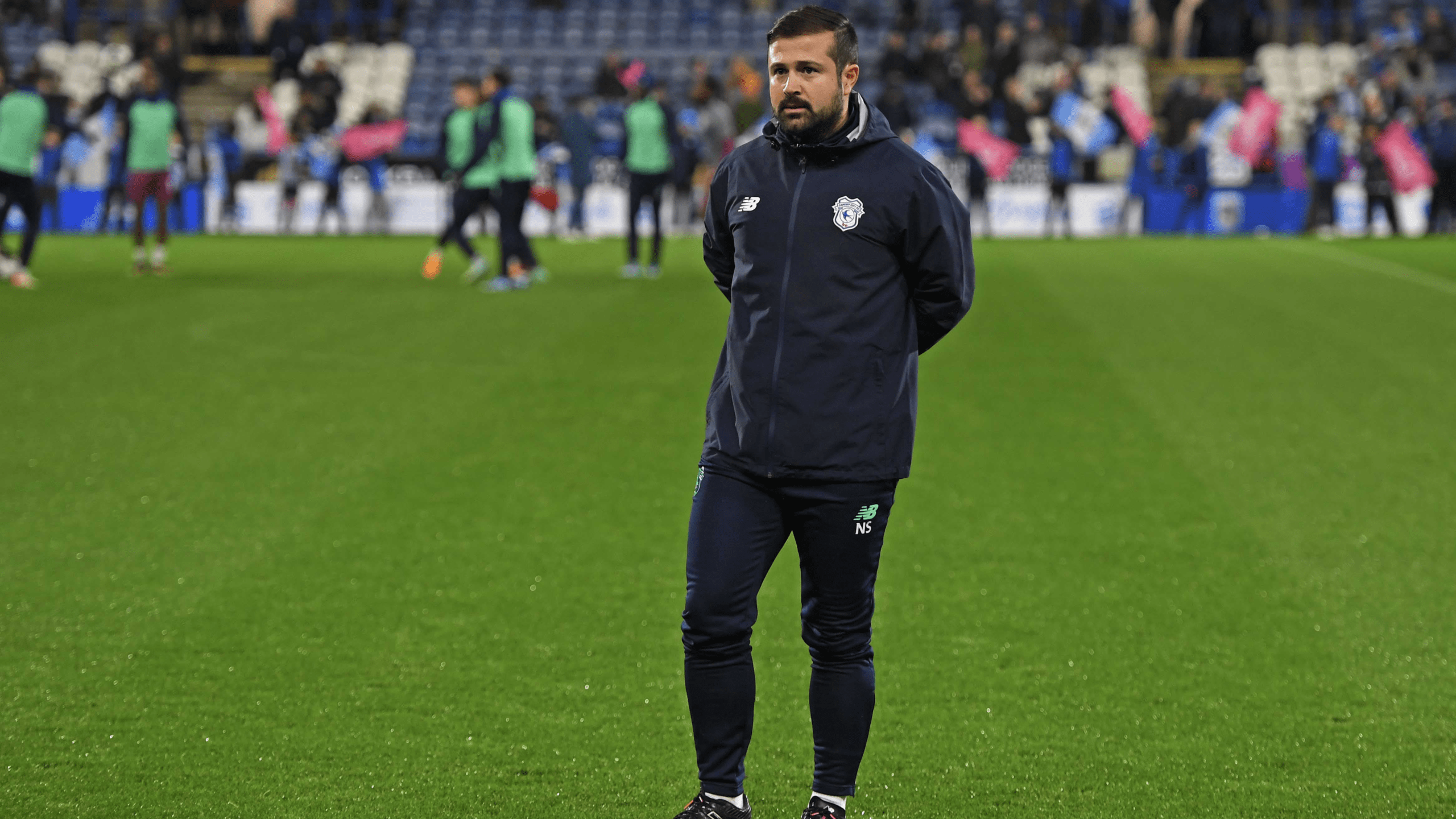
Nadir Sönmez is a highly qualified UEFA A Licensed football coach whose career spans Germany, England, and Türkiye and who is emerging as part of a new, modern generation of tactically intelligent, culturally adaptable, and academically grounded trainers. Born in Munich in 1990 and holding both German and Turkish citizenship, Sönmez combines the advantages of a multicultural background with strong roots in European football development.
His educational foundation is exceptional by industry standards. After completing a Bachelor’s degree in Coaching and Sports Management, he earned a Master of Science in Exercise Science and Coaching from the German Sport University Cologne. This academic background strongly shapes his analytical approach to training design, tactical development, and long-term performance planning.
His educational foundation is exceptional by industry standards.
Professionally, Sönmez has gathered experience across nearly every essential layer of modern football. He worked as an assistant coach for the Turkish U21 National Team, gained valuable insight into English football during his time with Cardiff City FC in the EFL Championship, and held senior coaching roles in Germany with clubs such as Fortuna Köln and 1. FC Köln Women II. His youth coaching résumé is equally impressive, having won multiple league titles with U16 and U17 teams at clubs including Wuppertaler SV, FSV Duisburg, Kasımpaşa SK, and Viktoria Köln.
Fluent in Turkish, German, and English, with additional Spanish skills, Sönmez is highly adaptable in international environments. He is known for his calm leadership style, structured methodology, tactical clarity, and his ability to connect with players on a human level. As he prepares for the next step in his career, Nadir Sönmez presents himself as a coach ready to take on greater responsibility and bringing intelligence, adaptability, and modern football thinking to ambitious projects.
He is known for his calm leadership style, structured methodology, tactical clarity, and his ability to connect with players on a human level.
Our exclusive interview with Nadir Sönmez
You have coached in Germany, England, and Türkiye — three very different football cultures. How have these environments shaped your identity as a modern coach, both tactically and personally?
This cultural combination allows me to approach problems from different perspectives, often producing very different solutions. These perspectives provide a high level of observation not only in the tactical field but also in human relations. Good observation requires analytical thinking and empathy. Understanding people and reading the game are, in my opinion, the most important parts of this profession.
You hold a Master’s degree in Exercise Science and Coaching and several advanced coaching certifications. How does your academic background influence your day-to-day work on the pitch and your long-term development philosophy?
Understanding training science and the details of conditioning parameters enables me to plan technical and tactical work in the most effective way. This contributes significantly to tactical development on both macro and micro levels. Together with systematic thinking, the pedagogical aspect of planning makes a big difference whether in youth or professional football. That is why having an academic background and combining it with modern football has benefited me greatly.
You have already worked in both elite youth development and senior football. How do you adapt your coaching approach when working with young talents compared to experienced professionals?
It is crucial to give young players the same value that is given to professional footballers. At the same time, it is important to convey to professional players that learning is never complete just as we emphasise with young athletes. I believe it is essential for every player, regardless of age or experience, to receive accurate and timely feedback. What I mean is that I often do not see major differences between player groups the real difference lies in the coach’s working principles and style.
Many of your youth teams achieved title-winning success. What specific principles or methodologies do you apply to create high-performing, resilient, and intelligent teams?
I focus on systematically planning exercises that develop players’ thinking and decision-making abilities, always aligned with the main objective of the training session from warm-up to the final drill. Every step taken during the session should serve its overall goal, and players should understand clearly why they are doing each exercise.
Playing fast, regaining possession quickly and not losing the ball easily are, in my opinion, essential principles. However, the most important factor is knowing which game model suits the players best. In addition, I place great value on individual development and treating each player with the attention they deserve.
You worked in the EFL Championship with Cardiff City FC — a very demanding league. What were your biggest takeaways from English football, and how did that environment accelerate your growth as a coach?
My detailed experience across 50 matches in the FA Cup and Carabao Cup during my time in the English second division was the pinnacle of my career. I learned how to plan effectively under a demanding match schedule. Sometimes you even have to anticipate in which matches you might drop points.
This period taught me how to manage the physical and mental fluctuations that occur throughout a season. Observing formation changes during matches and analysing the resulting advantages and disadvantages was an invaluable learning process. You also realise that even the most important players make simple fundamental mistakes and that every player needs feedback, positive or negative.
Through individual technical and tactical analyses, I gained deeper insights into the game and the players. It was a wonderful, educational experience for me.
What is the core of your coaching philosophy? Which values, tactical concepts, and psychological principles define you as a trainer?
It is not the strongest who survive, but those who adapt best. For me, the most important ability is adapting to what the club and the team can realistically achieve. A good coach must be able to prepare a team according to any philosophy or tactical approach, because ideal conditions are not always available. You must be familiar with every style of play.
If I had to name one key criterion, it would be the ability to regain possession quickly an absolute must for me.
As someone who speaks several languages and has coached in multiple countries, how important is communication and cultural awareness in building trust and strong team dynamics?
I believe that using different languages is one of the best ways to develop empathy, because every language has its own structure and that structure shapes a person’s character. Coaching in Turkish, German and English has given me very diverse qualities and perspectives.
Looking ahead, what type of club, project, or environment do you feel would allow you to bring your full coaching identity to life? And what can a future employer expect from you as a leader and football educator?
Sustainable long-term projects may be every coach’s dream, but in football this is only possible in very few clubs. That is why it is essential to work meticulously and achieve success under any circumstances. A good teacher can provide the best education even in the most challenging classroom.
Promoting to a higher league with an unpredictable club or becoming champions is, in my opinion, one of the most charismatic and meaningful moments in this job.