

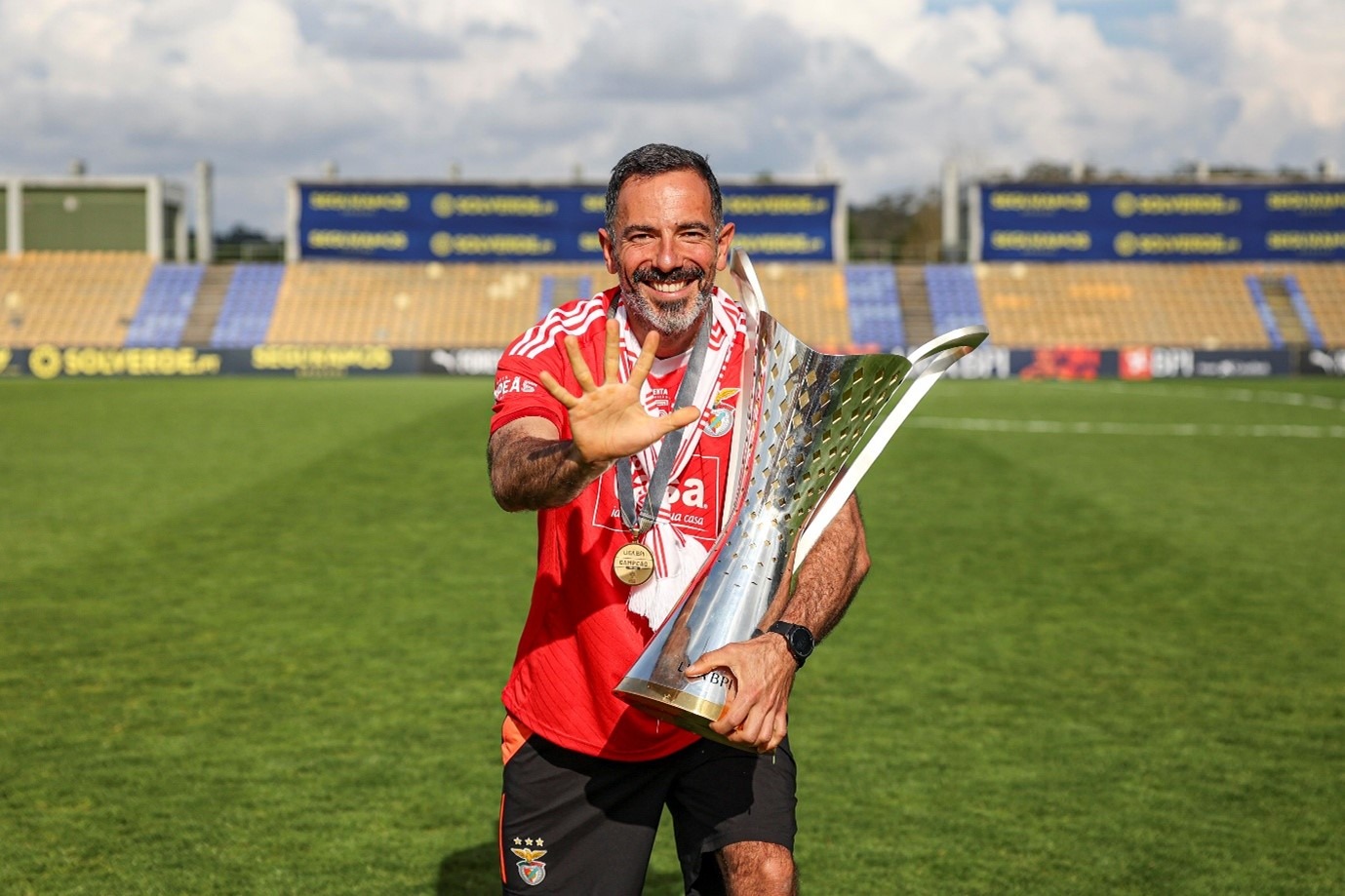
André Vale is a Portuguese football coach, mentor, and educator, known for his principled and holistic approach to developing both players and teams. With over a decade of experience at Sport Lisboa e Benfica, Vale has played a pivotal role in building one of the most successful women’s programs in Europe. As Head Assistant Coach of Benfica Women’s First Team since 2020, and after several roles as headcoach both in male and female football, he has helped lead the team to five consecutive league titles, multiple cup victories, and a historic UEFA Women’s Champions League quarter-final, most notably, the match that ended FC Barcelona’s 32-game winning streak.
Vale’s coaching philosophy is rooted in clarity, adaptability, and player-centered development. He believes in simplifying the chaos of the game through principle-led coaching, game-based learning, and fostering mental, emotional, and spiritual growth alongside tactical excellence. His tactical identity is defined by flexibility, high pressing, and bold attacking football, with a focus on turning complexity into solvable moments on the pitch.
Central to Vale’s work is the creation of environments where players from different cultures, ethnicities, and experience levels can grow together. He places strong emphasis on trust, open communication, and shared principles, ensuring every player feels seen, valued, and challenged. By aligning individual backgrounds with collective goals, he promotes mutual respect, accountability, and learning, transforming diversity into a competitive and human strength within the team.
Beyond coaching, Vale is a tutor on UEFA license courses across Portugal, a frequent guest on Benfica TV, and a published author. His book Coaching Football to Inspire (2025) reflects his mission to develop players and teams who make a difference, on and off the pitch. He is also the creator of Who Coaches the Coach?, a 7-hour online course aimed at empowering coaches at all levels.
Fluent in Portuguese and English, and with experience living in Italy, Ireland, the Netherlands, and the UK, Vale brings a global mindset to his work. Whether leading elite players or mentoring young coaches, André Vale is committed to football not just as a game, but as a tool for education, joy, and lasting impact.
Our exclusive interview with André Vale
Who is André Vale outside of football?
I’m someone who has always been fascinated by people, dreams, and what makes us come alive. I’m a family person, a husband, a dog and cat parent, and someone who finds peace in early mornings, nature, journaling, training and yoga. My background is in engineering, but my heart was always on the pitch. I’ve lived in several countries, worked many jobs, and coached across different environments, but who I am, has always been shaped by my core values which are respect, honesty, justice, and empathy. I try to live simply, give generously, and stay grounded in joy, curiosity and adventure.
I’m someone who has always been fascinated by people, dreams, and what makes us come alive.
You have been pivotal in leading Benfica Women to five straight league titles and a Champions League quarter-final, among other Cup’s titles. What has been the secret behind such consistent success?
First of all, it was always a multidisciplinary team effort together with amazing players with a huge will to win, but to improve, to shine and develop. If there is a secret that was the secret. Just a lot of clarity, consistency, and collective commitment. We focused not only on how we play but on why we play. Success came because we created a culture where players feel joy, responsibility, and freedom at the same time. We don’t just train tactics, we develop people. We built a process rooted in principles that allowed us to adapt, evolve, and perform. And most importantly, we respected the players’ dreams every step of the way.
You often speak about emotional intelligence, spiritual balance, and joy. How do you bring these values into the high-pressure world of elite football?
For me, pressure is not the enemy. Disconnection is. When players feel connected to themselves, to the team, and to something bigger than just the scoreboard, pressure becomes fuel. I try to help to create an environment where there is emotional safety and high challenge. We talk about mindset, values, and self-awareness as much as we talk about tactics. I meditate, I journal, and I encourage the same in players if they’re open to it. Joy is not a soft word. It’s a powerful force in high performance. We are never afraid to lose; the only thing we’re really scared of is to lose ourselves.
You’ve coached both youth players and senior professionals. What are the biggest lessons you’ve learned from those different contexts?
One of the biggest lessons is that coaching isn’t about age or level. It’s about connection. A seven-year-old and a Champions League player both want the same thing: to be seen, understood, and guided. I normally say we’re all children stuck in adult’s bodies, so being with youth, where you plant seeds, with seniors, you help shape the tree, but both require trust, clarity, and presence. Also, with youth you must be extra mindful because that’s the golden age of learning, and your words can shape not just their game, but their character.
You describe football as “chess in motion” and talk about simplifying the chaos. How do you do that in practice?
Football is chaotic by nature, it’s 22 people inside the pitch plus coaches trying to manage the game from the outside, so it’s 22 brains processing information at the same time, it will be chaotic, question is who can manage that chaos better, who is better equipped to understand chaos and lead that chaos into moments of organization and brilliance that will hopefully result in amazing plays and goals! So a big part of my job is to develop a methodology that puts the players to the small games that the game gives over and over in training sessions, so that when on the pitch they can automatically and subconsciously recognise those moments and have the best and fastest decision making they can to unblock it. When those moments happen in a match, players feel like they’ve already lived them 100 times. That’s where the freedom comes from. Structured repetition that leads to spontaneous, intelligent action. We train situations, not just drills.
What excites you most about the future of women’s football globally?
Women’s football is one of the most exciting movements in global sport right now. For me it’s not just sports, it’s expression of freedom. The talent, the hunger, the growth, it’s inspiring. What excites me most to have a part on it is the opportunity to build something meaningful, not just successful. To create environments where players are treated as professionals, where pathways are clear, and where fans feel part of something transformative.
You created a course called “Who Coaches the Coach?” What is one mindset shift you hope to spark in those who learn from you?
I want coaches to remember that they matter. Not because of the formations they choose, but because of the impact they can have on lives. I want them to stop obsessing over being right and start focusing on being helpful. Coaching is not about control. It’s about guidance. And your best tool is who you are, not just what you know. I always say: you fulfil your dreams by helping others fulfil theirs. That’s the mindset I try to share.
How do you define success in your coaching journey?
Success, for me, comes in many forms. Of course, I celebrate trophies and milestones. But some of my proudest moments are messages from former players telling me how I helped them become better players and individuals. Or watching someone I believed in overcome a huge personal challenge. Success is when a team plays with joy and identity. Success is when a quiet player finds their voice. It’s not just the Champions League. It’s the little victories that no one sees but change everything.
Joy is not a soft word. It’s a powerful force in high performance.
You’ve lived in several countries. How has that international experience shaped your actual football and your leadership?
Living abroad taught me to listen more and judge less. It showed me the hardships of being away from loved ones, habits, and routines—but also how to discipline and motivate yourself to discover strengths you didn’t even know you had.
Those experiences allow me today to better understand player adaptation. Whether it’s players coming from different countries with language barriers, or players moving within the same country, the emotional and cultural challenges are very real.
Living abroad also taught me that if you want to thrive in a foreign environment, you have to be available to blend in. That means observing, understanding, being curious, and opening yourself to different experiences. This is probably the main reason why I love working in multicultural environments and fostering the sharing of experiences within the group. It shortens adaptation time for new players and helps build a genuine family feeling within the squad.
Football is a universal language, but understanding the people behind the players is what truly makes the difference.
What’s one lesson or philosophy that you carry with you on and off the pitch?
One lesson I carry with me is that growth comes from discomfort, but purpose comes from helping others grow. Early in my journey, I chased success and happiness for myself. Over time, I understood that real fulfillment only exists when it’s shared. When you invest in people, when you help them believe, improve, and overcome obstacles, you create impact that goes far beyond results.
On the pitch, that means demanding excellence while caring deeply about the person behind the player. Off the pitch, it means showing up with humility, empathy, and consistency. Success fades, but the way you help others grow stays with them for life, and that’s the standard I try to live by every day.