

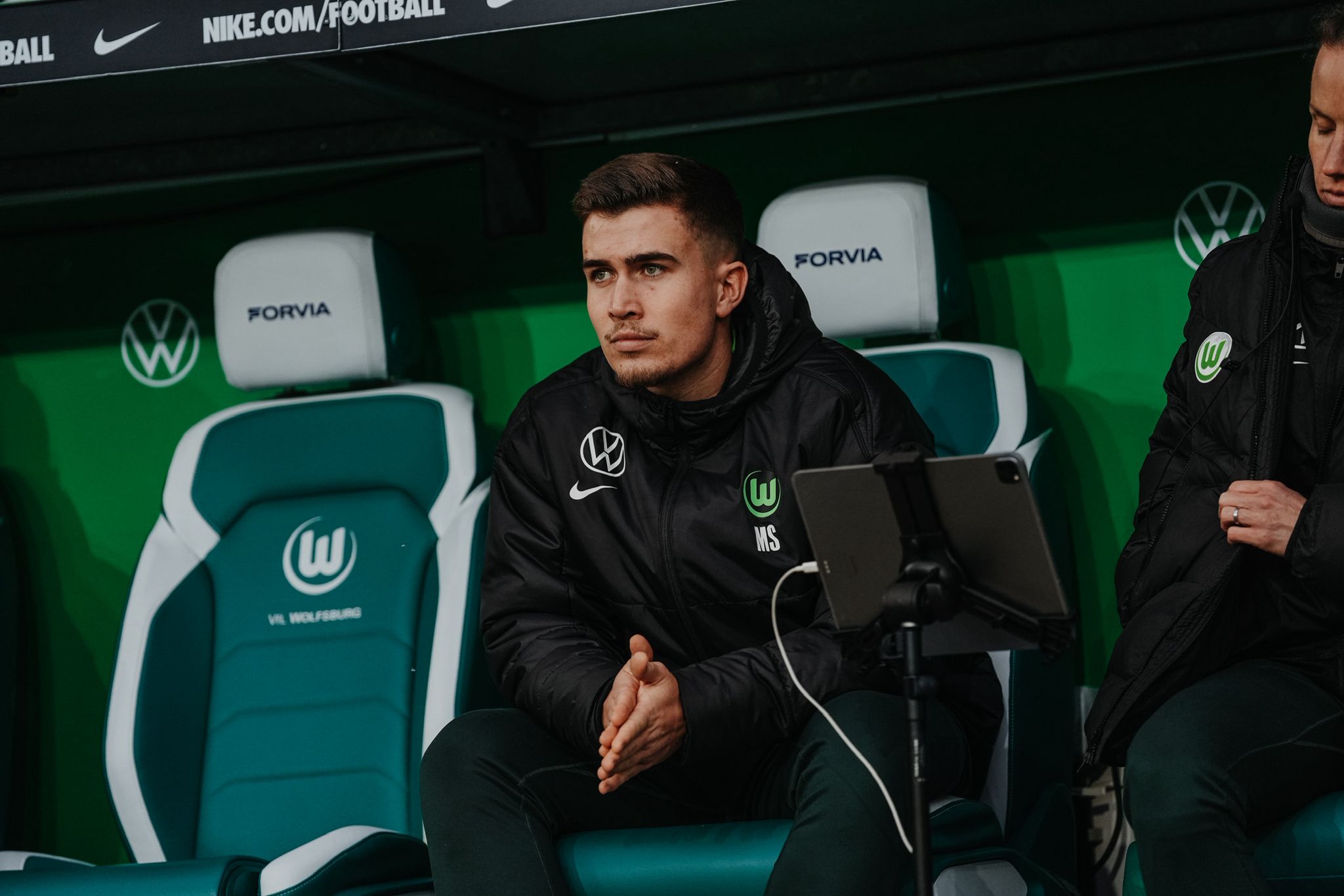
A rising figure in elite goalkeeper coaching
When a 15-year-old goalkeeper from Düsseldorf was told he would one day become a great coach, he didn’t realise his mentor was predicting the future, but he proved him right faster than anyone expected.
Marcel Schulz is one of the youngest established goalkeeper coaches in European football. At just 25, he has coached at SGS Essen, Eintracht Frankfurt and VfL Wolfsburg Women, working with top German goalkeepers including Merle Frohms, Stina Johannes and Anneke Borbe. Before entering the Frauen Bundesliga, he spent several years with the DFB youth national teams and supported the German men’s national team as a goalkeeper analyst during the preparation for the UEFA EURO 2021.
Holding the DFB Goalkeeper A Licence, Schulz is known for his detailed, modern and individualised approach to goalkeeper development. His coaching philosophy is rooted in precision, tactical understanding and a strong focus on decision-making, reflecting a new generation of German goalkeeper coaches.
Our exclusive interview with Marcel Schulz
You are only 25 but already an established goalkeeper coach in the Bundesliga. How did your coaching journey begin, and what inspired you to specialise in goalkeeping so early?
I started at Fortuna Düsseldorf in the youth teams. When I stopped playing at the highest level, I focused on earning my coaching licences. The biggest influence was my former goalkeeper coach Christian Lasch. When I was 15, he told me that I would become a good coach one day and that I should start getting my licences early.
He was also the one who hired me as a goalkeeper coach at the academy when I was 16. Thanks to him, I learned everything about goalkeeping from the youngest age groups onwards and gained the confidence to coach at an NLZ at such a young age. Many people who know us both still say they recognise his influence in my coaching style today.
Since I had always been a goalkeeper, specialising in this position felt natural. My motivation has always been to make goalkeepers better and help them reach a higher level. When I was 18, I met Silke Rottenberg, who introduced me to women’s football.
The biggest influence was my former goalkeeper coach Christian Lasch. When I was 15, he told me that I would become a good coach one day and that I should start getting my licences early.
You spent four years as a goalkeeper coach with the DFB youth national teams and also worked as an analyst during the buildup to EURO 2021. What experiences from that period have most influenced your current coaching philosophy?
I am very thankful for the opportunity the DFB gave me. Most of my time there was spent with the youth national teams, which gave me a deep understanding of the developmental pathway on the men’s side.
Supporting the men’s team as a goalkeeper analyst during the preparation for EURO 2021 was a very special experience. It allowed me to study elite male goalkeepers closely, and afterwards the differences between men’s and women’s goalkeeping became even clearer.
In women’s football, we need to invest much more time in technical and tactical precision. Every step, angle and movement towards the ball has to be extremely efficient. Female goalkeepers generally need to make even more accurate decisions. Techniques and starting positions also differ. That experience shaped my understanding of what elite women’s goalkeepers truly need.
At SGS Essen, Eintracht Frankfurt and now VfL Wolfsburg, you have worked within very different club cultures. What did each station teach you about elite goalkeeper development?
All three clubs were completely different experiences.
In Essen, we had very limited financial resources. It was all about connection, unity and a family environment. For me, it was the perfect introduction to women’s football. I enjoyed going to work every day, developed myself and gained a real understanding of the game.
Frankfurt was a major step towards professionalism. The department was newly founded, and we were able to build structures from scratch. Working with Merle Frohms had a big impact on me. Seeing how precisely she worked on even the smallest details showed me what world class mentality looks like.
Wolfsburg was the step to top international level. The ambition of the club is visible every day. You give everything to achieve your goals. During this period, I learned a lot about the tasks of a goalkeeper coach off the pitch, including analysis, preparation and scouting.
You have worked with top goalkeepers such as Merle Frohms and Anneke Borbe. What defines a modern goalkeeper in your eyes, both technically and mentally?
Working with world class keepers is always special because each of them is unique. You cannot compare them. Every goalkeeper has her own style, and the key is to work with individual strengths.
With Merle Frohms, who uses her feet extremely well, we worked on understanding when to use hands instead of feet while keeping the elements that made her world class.
With Anneke Borbe, who came from eight years at Werder Bremen and moved into a top international environment, we worked primarily on her presence and confidence. But also in all other goalkeeping areas: low pushes, crosses, and high balls. Her development was extremely fast and she eventually became the number one.
At elite level, individualisation is everything. What separates the top goalkeepers I have worked with is their mentality. They want to improve every day, stay after training and even work on days off. Sometimes I had to slow them down to manage the load.
My philosophy is to train as you play. Sessions build towards realistic match scenarios, ending with a situation they have faced or might face in a game. The final part is about decision making. Afterwards, we analyse those decisions together at eye level. I want to convince them with arguments, but I am open to individual solutions if they are equally effective.
At elite level, individualisation is everything. What separates the top goalkeepers I have worked with is their mentality.
Technology and data play an increasingly important role in goalkeeper coaching. How do you combine analysis and intuition in your daily work?
A lot depends on your coaching style, but for me the most important tools are match video analysis and identifying situations we can solve better in the next game.
Being a goalkeeper coach involves far more than what happens on the pitch. I analyse the opponent’s goalkeeper before every match to help our strikers, using match sequences and statistics, for example for penalties.
On the pitch, intuition becomes more important. Data helps you understand tendencies, but you cannot individualise training if you focus only on statistics. The feeling for the situation always comes first.
Having coached in both men’s and women’s football, what are the key differences in approach, communication, and player development?
There are clear differences, especially when comparing men’s youth football with the pathway young goalkeepers experience in women’s football.
In boys’ academies, players often have professional structures from a very young age. By the time they are 15 or 16, many already have access to top facilities and daily high performance training. When they reach a first team environment, they have had around ten years of elite coaching. The work focuses on decision making and tactical refinement.
In women’s football, young goalkeepers often do not have this level of structure early on. When they reach the first team, they are usually far from their maximum potential. You have to develop them in every aspect: professional habits, technical foundations and tactical movements.
The biggest development step usually happens in their first year with the first team, when they train daily in a high performance environment for the first time.
You hold the DFB Goalkeeper A licence and continue to work in high performance environments. How important is structured education for young coaches entering the profession?
Coaching licences are the foundation of your career. As a young coach, you do not have the long playing career or experiences that older coaches often rely on. You need strong technical, tactical, psychological and athletic knowledge.
To be a high level coach at a young age, you have to be a “nerd” in every detail. You need to absorb information constantly. You convince goalkeepers through knowledge and methodology, not through your past as a player.
Looking ahead, what are your long term ambitions in football, and how do you see the future of goalkeeper coaching evolving?
In women’s football especially, I see a bright future for goalkeeper coaches. The game is developing quickly around the world and there are more opportunities than ever to experience different countries and cultures.
For me personally, it is about taking the next steps. I want to earn more licences and continue developing as a coach. I do not set long term goals because I like to enjoy the moment and focus on helping the goalkeepers I work with improve and hopefully have a positive impact on their careers.