
From Bundesliga striker to football executive
Fredi Bobic is one of German football’s most recognizable figures — both on the pitch and in the boardroom. Born on October 30, 1971, in Maribor, he became known as a powerful striker, playing 285 Bundesliga matches for clubs such as VfB Stuttgart, Borussia Dortmund, Hannover 96, and Hertha BSC. He won the European Championship with Germany in 1996, finished as the Bundesliga’s top scorer that same year, and added a DFB-Pokal title (1997) as well as a Bundesliga championship (2002) to his résumé.
After ending his playing career in 2006 at Croatian club HNK Rijeka, Bobic transitioned into football management. His first executive role came as CEO of FC Chernomorets Burgas in Bulgaria. In 2010, he returned to Germany to become Sporting Director at VfB Stuttgart, where he later also served on the club’s executive board and oversaw major squad development initiatives.
In 2016, Bobic joined Eintracht Frankfurt as an Executive Board Member. His tenure included several high points, most notably the 2018 DFB-Pokal triumph and strong Europa League performances.
He later became Executive Board Member at Hertha BSC, though his time there ended abruptly in January 2023. Additionally, he served on the Supervisory Board of the Deutsche Fußball Liga (DFL) from August 2022 to February 2023, gaining experience in league governance.
In 2025, Bobic took on a new challenge as Head of Football at Legia Warsaw in Poland.
Renowned for his eye for talent, negotiation skills, and his ability to build sustainable sporting structures, Bobic remains an influential figure in world football. His journey from “magical striker” to high-level executive showcases both his passion for the sport and a sharp, strategic mind.
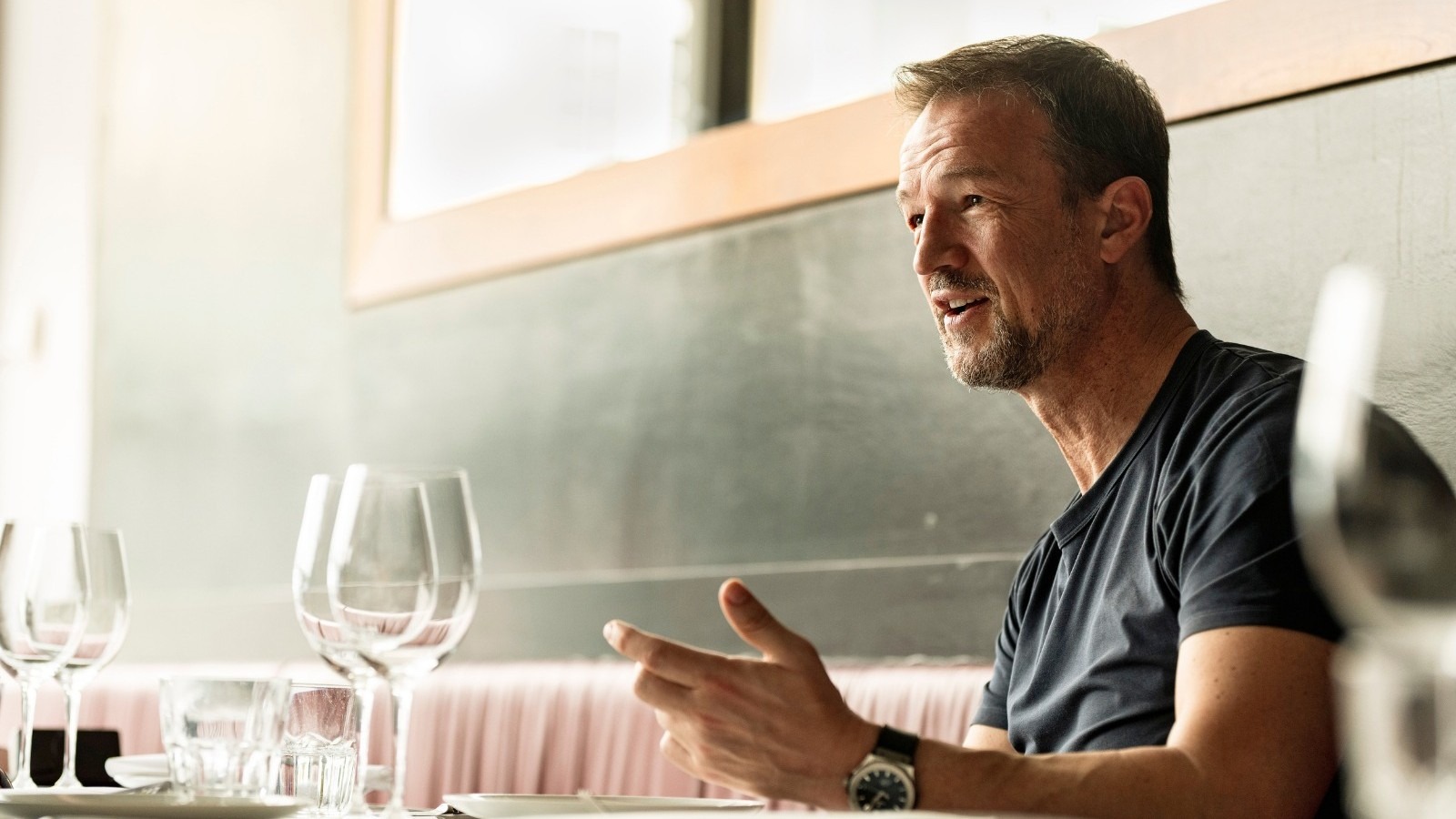
Our exclusive interview with Fredi Bobic
Fredi, you were born in Maribor, Slovenia, and moved to Germany at a very young age. How was that transition, and how did you get into football?
My parents were already living and working in Germany, so integrating was quite easy for me. Football always played an important role in my childhood. My friends and I played every day on concrete pitches in our neighborhood. We didn’t join a club until we were seven years old — it was something we decided together.
You enjoyed a prolific playing career across the Bundesliga and abroad. Looking back, which phase shaped you the most as a footballer and why?
Especially in the 1990s, football was already going through major changes. I found myself right in the middle of a generational shift, as the sport became more diverse and areas like marketing, merchandising, and entertainment grew in importance. This long transformation process fascinated me — and made that period the most exciting for me, both as a player and as a person. It was during those years that I already decided I wanted to become a club executive one day.
This long transformation process fascinated me — and made that period the most exciting for me, both as a player and as a person.
You were part of Germany’s EURO 1996 winning squad. How did that experience influence your mindset and leadership later in football management?
As a young player, I learned a lot from winning the title in England. Our motto was: “The star is the team.” Everyone acted accordingly — on and off the pitch. The energy of subordinating everything to the team and to a common goal was extraordinary. That feeling still connects all of us to this day, and we remain in close contact.
As a leader today, it’s important to me to bring everyone along. You can achieve something on your own — but the greatest successes only come when you do it together.
You can achieve something on your own — but the greatest successes only come when you do it together.
At VfB Stuttgart, you were part of the famous “Magisches Dreieck.” How did that partnership influence your development on and off the field?
When people understand each other almost “blindly,” trust each other, and are loyal, things like the “Magical Triangle” with Élber and Balakov can happen — it was a special period at Stuttgart. Even in my current roles, the people around me who share sporting values and objectives are crucial. I’ve been fortunate to work with many outstanding players and later outstanding staff members who all pulled in the same direction.
Your time at Eintracht Frankfurt is widely seen as one of your greatest successes as an executive, culminating in the 2018 DFB-Pokal win. What key decisions or strategies made that project so successful?
My philosophy is leading by example. I can only demand everything from players, coaches, and staff if I demand everything from myself. The progress we made in scouting with Ben Manga, the development in analysis and research with Sebastian Zelichowski, the medical department’s evolution with Bruno Hübner, and the cooperation with the Supervisory Board were crucial.
And the mutual trust with both head coaches — Niko Kovač and later Adi Hütter — took us to another level. It was a collective team effort, and I had the privilege to lead it.
You have held leadership roles at Stuttgart, Frankfurt, and Hertha BSC. How would you describe your philosophy as a sporting director, and how has it evolved?
My goal is always to empower the key people in a team to make decisions independently and to react effectively to change. People management and solving problems quickly to keep moving toward our goals must always be at the core of a manager’s responsibilities.
Modern football places huge emphasis on data, scouting networks, and long-term roster planning. Which areas do you think are most critical for clubs today?
Data is an extremely important tool in scouting today. Every club must decide which data points are relevant for its strategy. Data is very helpful in identifying players, but one thing must never be forgotten: the conversation with the player.
His behavior, character, mentality, and whether he fits the team — data cannot measure those things. The right balance between both approaches leads to the right decisions. Short- and medium-term squad planning is absolutely vital.
Next year, the World Cup will take place in the United States. During your time at Eintracht Frankfurt, you opened an office in New York. How do you see the development of football in the U.S., and could you imagine taking a step into MLS?
I’ve been traveling in the U.S. for 30 years, visiting many MLS clubs, universities, and also teams from other major sports like the NFL, NBA, and NHL. The insights into their data usage, medical structures, and athletic development have always helped me implement ideas in my own clubs. Of course I can imagine working in this growing league one day. In 2015, I had very intensive discussions with the Philadelphia Union, and I’ve stayed in touch with other clubs in recent years. You never know what the future holds — I always let things come to me. The global world of football has always fascinated me.