

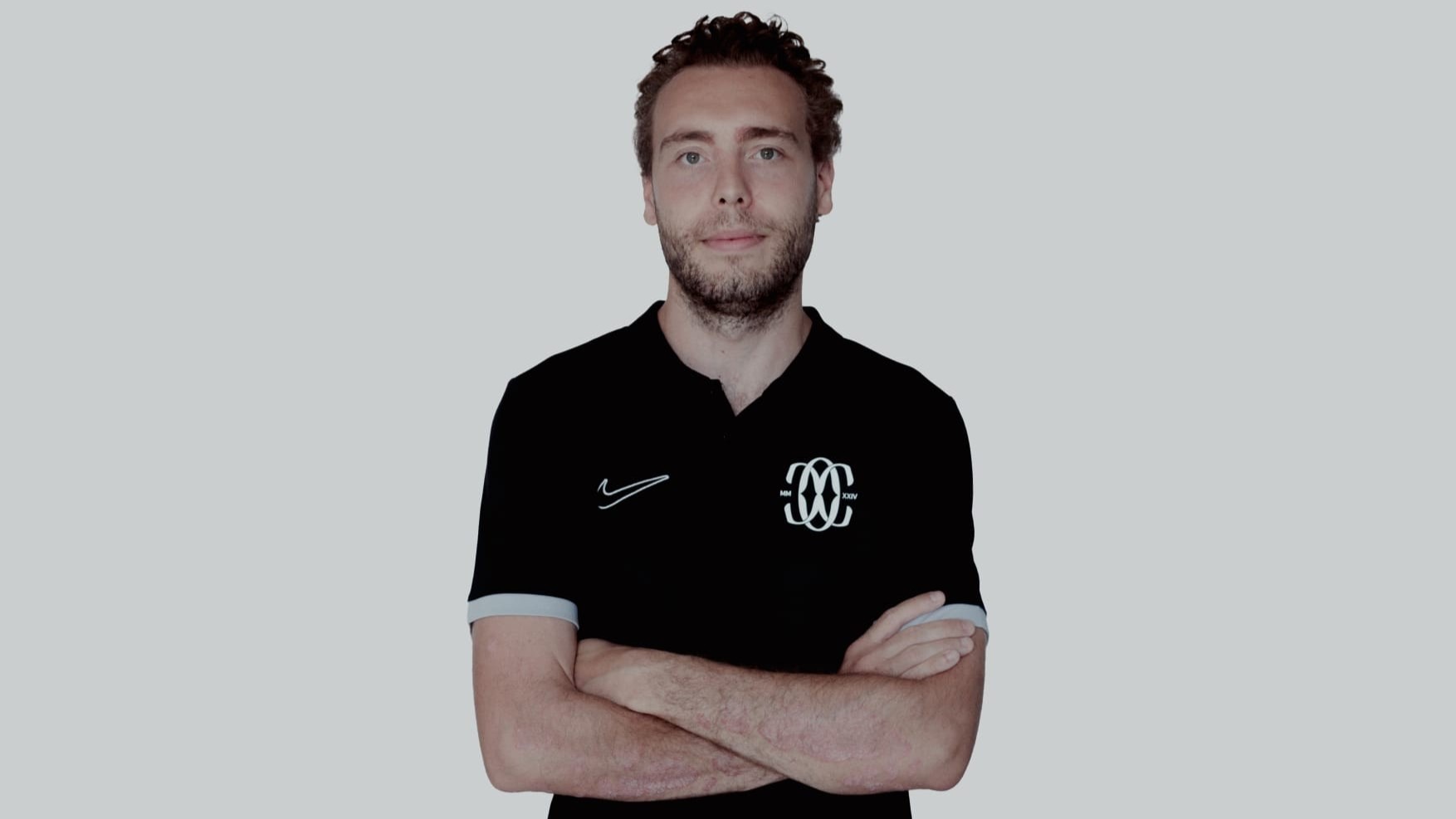
He sold lawn mowers before he ever scouted footballers, returned to school when the system offered him no path forward, and built a football career without having played the game professionally. Today, Gianni Piccatti is one of the most intriguing young minds in European women’s football.
Gianni Piccatti is the Scouting Manager at FC Como Women, where he plays a central role in player evaluations, transfer operations and international recruitment. Known for his multilingual background, analytical mindset and unconventional path into the sport, he has developed a unique perspective on how clubs operate, how departments interact and how talent is identified. His experience ranges from event management to coaching, from data and analysis to adaptive sports environments such as Atalanta For Special and the Luxembourg Paralympic Committee.
What makes Piccatti stand out is not only his football competence, but the resilience and curiosity that define his career. From a hardware store apprenticeship at age 15 to scouting in Serie A Femminile, his journey reflects an industry increasingly shaped by diverse skill sets and multidimensional leaders.
“You can learn anything if you really want to.”
Our exclusive interview with Gianni Piccatti
You are currently Scouting Manager at FC Como Women. What are your main responsibilities in this role, and how does your approach to scouting differ in women’s football compared to men’s?
As a Scouting Manager, my primary responsibility is to identify and assess talent that can improve our current squad. I have the privilege of working directly with our Sporting Director, supporting him in evaluating players, communicating with agents, taking part in transfer negotiations and welcoming new players to the club.
Since I speak five languages, I naturally build and maintain international relationships. Beyond that, I do much of what you expect from a scout: watching football and spending a lot of time in spreadsheets.
The main difference compared to the men’s game is that you operate in a much faster changing environment with fewer available resources. Federations professionalising leagues, new clubs entering the women’s game or increased investment can drastically change the scouting landscape from one transfer window to the next.
Information about contracts, statistics or even video footage is not always as easily available as on the men’s side, but that is also what makes the job dynamic and enjoyable.
You have already gained experience across several areas of sport, from event management to coaching and analysis. How have these different roles shaped your perspective on football management?
I always aimed to work in a managerial role in sports, so I wanted to understand the different realities within different organisations. Today, people are expected to specialise in one specific field. Specialists are essential, but relying too much on them creates blind spots across an industry.
Sports is already a niche, and football within it is another niche that we further break down into highly specialised departments. Working across different functions allowed me to understand how a decision in one department can affect many others. The lack of cooperation can create tension and misunderstandings.
A specialist view is usually narrow. My broader background helps me see the full picture and stay open to alternative perspectives.
For example, scouts often ignore the commercial value of a signing because they focus on evaluating qualities on the pitch, which is absolutely their main job. But when you understand the impact a player can have on sponsorship, visibility or brand recognition, you cannot ignore that aspect completely. A commercially valuable signing can increase revenues, which then benefits the scouting department in the long run with more resources and a stronger pull for future targets.
Your professional journey was not a typical one, from working in a hardware store as a teenager to returning to school later and eventually building a career in football. How did these experiences influence your work ethic and your view on opportunity in sport?
When I was 15, I failed in school and was left with no option but to start an apprenticeship at a hardware store because I was denied the chance to continue the education I wanted.
Working there taught me valuable lessons that have carried me to where I am today. I knew nothing about the equipment we were selling, yet I figured it out. You can learn anything if you really want to. Today, I work in football even though I never played competitively. Because I was able to sell lawn mowers without ever having mown a lawn, I firmly believed that I could work in football without being able to control a ball.
After finishing the apprenticeship, I contacted the director of my local high school and asked for permission to return to education. There was no clear path to what I wanted, so I created one myself. She accepted my request, and I entered a program where I studied alongside people four years younger than me.
It took me four more years to finish the degree, with no special treatment. That qualification allowed me to pursue higher education in International Sports Management and Business. I walked a path that technically did not exist in our system.
People doubted me and support was limited, but I believed in my own direction. That experience shaped me. I now see barriers as hurdles to jump over.
“If you are willing to give, you will be able to receive.”
At Atalanta For Special and the Luxembourg Paralympic Committee, you worked in inclusive and adaptive sports environments. What have these experiences taught you about leadership and motivation?
Both experiences shaped me in different ways.
At the Luxembourg Paralympic Committee, I met high performance athletes with visible disabilities. Seeing a shot putter compete without an entire leg changed how I think about sport. It taught me to focus on what can be done, not on what cannot.
For example, when I played badminton competitively, I had a major foot injury and was out for six months, but I never missed a training session. I came back stronger because I adapted sessions by sitting or standing differently. If an athlete can train without a leg, I can train with a foot injury.
Atalanta For Special taught me something else. When I moved to Bergamo, I wanted to get involved in football somehow. Despite not speaking Italian at the time, the project welcomed me. I gave everything to the players, but they gave me even more. For a full year, they were my only constant in Italy. Volunteering there helped me learn Italian and take my first steps on the pitch.
The lesson is simple. If you are willing to give, you will be able to receive.
Having lived and worked in Luxembourg, the Netherlands and now Italy, you bring a strong international background to your career. How has this multicultural experience influenced your communication and decision-making in football?
Speaking several languages and living in different cultures broadened my perspective. I always adapt my communication to the environment. In some cultures, you get straight to business. In others, you need a conversation over coffee first.
Language shapes thinking. Some terms are so powerful they travel across languages, like “Raumdeuter” becoming common in English after Thomas Müller popularised it. Speaking many languages allows me to understand different interpretations of the game.
I am open to how other cultures think, understand their reasoning and apply it to my life and work. For example, I started sleeping on the floor to fix back pain after learning it is common in many cultures. My friends thought I was crazy, but it worked.
Every culture has something to offer. Being open minded gives you more tools to solve problems. If your own culture does not offer a solution, another one might.
FC Como Women is a growing name in Serie A. What excites you most about contributing to the club’s project and long-term vision?
I have followed Italian football with passion my whole life. Being part of this environment sometimes still feels unreal.
FC Como Women’s unique position as a women-only club without decades of history makes us an underdog, a position I am very comfortable in. I am excited to see where Mercury 13 will take the multi-club ownership model and how the acquisition of more clubs will shape our reality in Italy.
With the potential promotion of Como 1907’s women’s team, a local rivalry could grow. Competition would increase, but it is also an opportunity to distinguish ourselves as the reference for women’s football in Italy. And who does not love a derby?
Looking ahead, what are your long-term goals in football? Do you see yourself continuing in scouting and coordination, or moving into a broader sporting director role?
My ultimate goal is to become a Sporting Director. I believe I have built a strong foundation for that role. My profile is unique because I do not have the traditional football background, so I still need to position myself correctly in the industry and jump over another hurdle.
Right now, I focus on learning, helping the club grow and developing as a professional. There is no rush as long as I am learning, enjoying myself and moving in the right direction.