

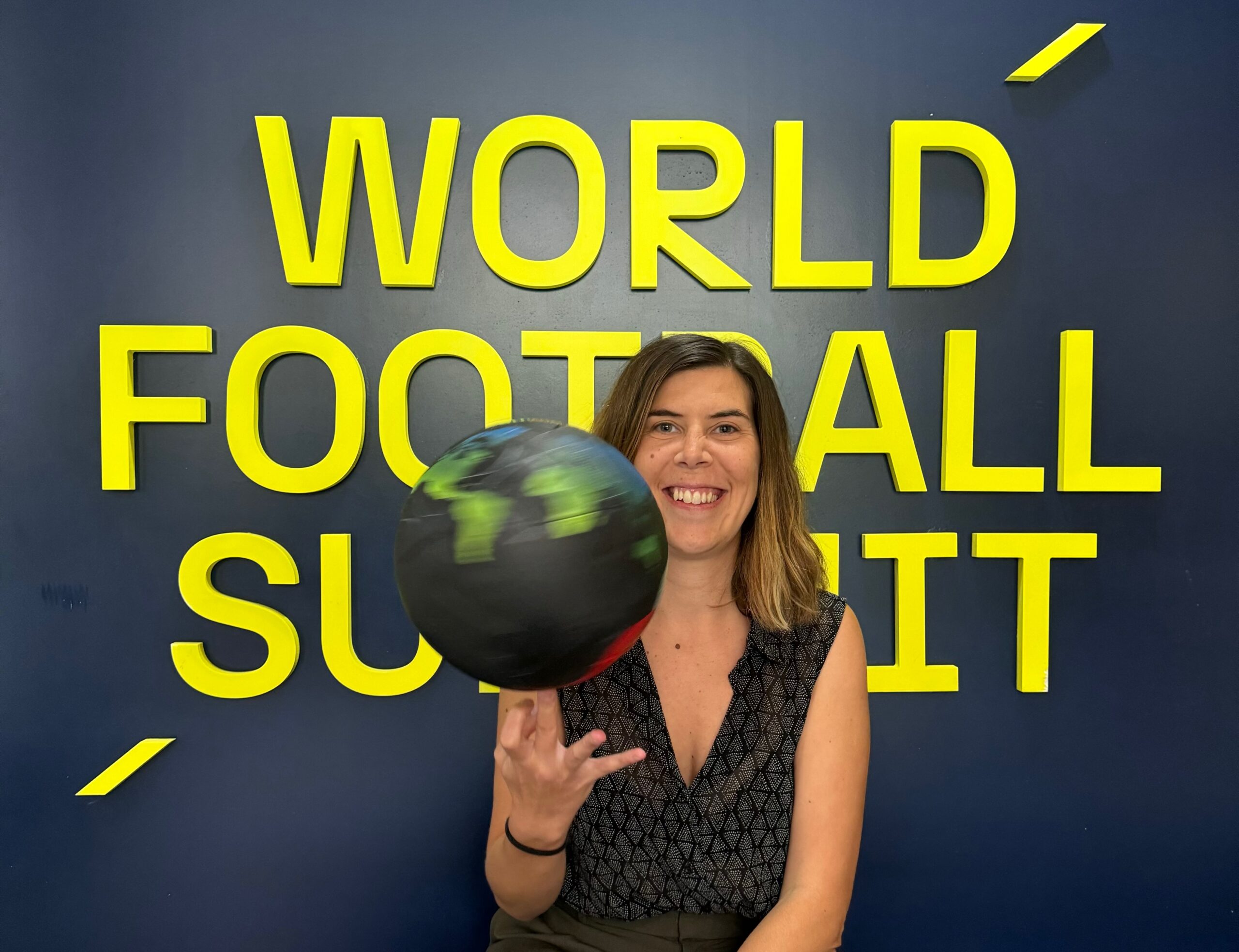
When a young film producer from Bilbao realised that storytelling could spark social change, she never imagined that the same tools would one day guide her work in global football.
Arantxa Mandiola is the ESG and Impact Strategy Manager at World Football Summit, where she has spent the past years embedding sustainability, equality and inclusion into one of the most influential platforms in the football industry.
Her background spans UNESCO, award winning impact production, digital education and international community projects across Africa, Europe and the United States. Today, she uses this cross sector expertise to shape how football organisations understand their responsibility and cultural power. With a film producer’s eye, a strategist’s mindset and a deep belief that football can drive societal transformation, Arantxa represents a new generation of leaders building a more inclusive future for the global game.
With a film producer’s eye, a strategist’s mindset and a deep belief that football can drive societal transformation, Arantxa represents a new generation of leaders building a more inclusive future for the global game.
Our exclusive interview with Arantxa Mandiola
You have been ESG and Impact Strategy Manager at World Football Summit for over a year. How would you describe your role and the kind of impact you aim to create within the global football industry?
At World Football Summit, my role is to integrate equality, sustainability, social inclusion and governance into both the structure of the Summit and the programme on stage. I co create the agenda for each event, making sure ESG is not a side topic but central to panels, workshops and activations. From the ESG department, we also design and implement our own initiatives, including the Female Leaders Program and The Most Inclusive Match.
My goal is to connect high level strategy with community impact, ensuring that discussions lead to action. We focus on three pillars: equality, inclusion, and environmental sustainability. In terms of equality, this means elevating women in leadership and creating spaces for emerging female talent to connect. The aim is to ensure women are not only visible on the pitch but present in decision making environments shaping the future of football.
On inclusion, we place strong emphasis on accessibility. We work to design events and football spaces where everyone feels represented and welcome, and we develop community activations that leave a legacy in each host city. For environmental sustainability, we aim to link football’s cultural influence with meaningful climate action. Responsible event operations and educational legacy initiatives are key. For example, in Hong Kong we organised bamboo planting sessions and environmental workshops with children. I truly believe football has the power to be a global force for positive change, and my work is focused on using its platform to inspire more equal, inclusive and sustainable societies.
ESG has become an essential topic in modern sport. What do you see as the biggest opportunities for football organisations to drive meaningful environmental, social and governance progress?
Football has a cultural reach that can shape behaviours worldwide. ESG in football is not only an opportunity, it is a necessity if the industry wants to remain responsible, relevant and forward looking. Clubs, leagues, players and organisations can lead by example through sustainable stadium operations, responsible travel and ethical merchandise practices, while creating legacy programmes that educate and involve communities.
Socially, football can advance inclusion, education and gender equality. Women’s football is already showing strong leadership here, with values rooted in community and authenticity. The greatest opportunity lies in becoming a catalyst for larger societal conversations. Much like the impact work I did on The Silence of Others, football can bring grassroots stories into mainstream spaces, influencing culture, education and civic engagement.
WFS brings together leaders from across the global game. How do you ensure that sustainability, inclusion and social impact are not only discussed on stage but embedded into the event itself?
We integrate ESG principles from the very beginning of the planning process. I work closely with both the content and operations teams to ensure that panels, workshops and activations reflect sustainability, inclusion and social responsibility. Gender inclusion is central to this. Through the Female Leaders Program and our commitment to a minimum of 30 percent female speakers, we highlight women’s leadership across the entire industry. Environmental initiatives are also built into our legacy approach. In Hong Kong, for example, we taught children how to plant and care for bamboo, combining environmental action with hands on learning. Community activation is equally important. Projects like The Most Inclusive Match or La Menina Tour create spaces for participation, celebration and visibility, leaving a tangible legacy that continues after the Summit ends.
Community activation is equally important. Projects like The Most Inclusive Match or La Menina Tour create spaces for participation, celebration and visibility, leaving a tangible legacy that continues after the Summit ends.
Your professional background spans UNESCO, creative production, digital education and award winning impact campaigns. How has this cross sector experience shaped your approach to ESG strategy in football?
It allows me to combine creativity with measurable impact. Film taught me how storytelling can spark conversations and drive change. If cinema can do that, football’s potential is enormous. At UNESCO, I worked with community radios in Namibia, Lesotho and South Africa, integrating social issues such as tuberculosis prevention, HIV awareness and gender equality into radio soap operas. Media gave a voice to underrepresented communities and strengthened local identity, something football can also achieve.
In impact production, I developed the campaign for The Silence of Others, co creating an educational guide with Amnesty International to bring lessons from the film into schools. It showed how storytelling can foster civic dialogue. This is a perspective I now apply directly to football, using the sport to inspire discussions around inclusion, leadership, sustainability and equality. Digital education has helped me scale knowledge, designing practical ESG learning frameworks for clubs, federations and associations. And throughout it all, football has been part of my life. I have always played, watched and supported the sport. It has taught me values, belonging and community. My approach to ESG in football is therefore not only professional, it is deeply personal.
You have managed and coordinated international projects in Africa, Europe and the United States. What have these multicultural environments taught you about building effective impact initiatives in sport?
The most important lesson is that meaningful impact must be rooted in context. Listening is essential. Every community has its own culture, needs and expectations, and initiatives succeed when they are co created with local stakeholders. At WFS, I apply this through a dual approach: engaging high level leaders in strategic ESG discussions while developing local activations such as environmental workshops and inclusive football events that leave a visible legacy. This ensures that global strategy is shaped by local realities and that grassroots initiatives gain recognition and support across the wider football ecosystem.
You specialise in long term impact production and community driven narratives. From your perspective, what does authentic and measurable impact look like in football?
Authentic impact begins with communities. It must be meaningful, participatory and sustainable. Projects like The Most Inclusive Match show inclusion in action, using football to inspire awareness and learning. Similarly, The Silence of Others demonstrated how community driven narratives can spark broader societal conversations. In football, creating spaces for women players and leaders to be visible can influence culture, shift social norms and strengthen engagement. What is not seen does not exist, so visibility is essential. Measurable impact requires combining qualitative insights with quantitative indicators. Monitoring and evaluation are crucial, ensuring that football initiatives do not remain symbolic but produce lasting change.
Working with federations, leagues, clubs and brands requires strong alignment and trust. How do you help organisations turn ESG commitments into concrete action?
Concrete action requires clarity, structure and facilitation, as well as honesty. It is important to define priorities, build partnerships and create frameworks that make ESG actionable and measurable. At WFS, we create spaces where leaders from federations, leagues, clubs and brands can collaborate, exchange best practices and commit to meaningful initiatives. By connecting organisations with programmes like Common Goal, environmental initiatives or mentorship schemes for women leaders, we help turn commitments into operational reality. My role is to bridge strategic ambition with practical execution so that ESG becomes an ongoing, measurable practice rather than a one time discussion.
Looking ahead, what is your vision for the future of ESG in football, and how do you see your own role evolving as the industry continues to grow?
I imagine a future where ESG is fully integrated into football’s identity, operations and cultural influence. Sustainability, inclusion and gender equality will be embedded at every level, while the football community, particularly women in leadership, will continue shaping broader social trends. Football will serve as a catalyst for conversations far beyond the game. My role will evolve alongside this, connecting high level strategic leadership with grassroots initiatives and crafting narratives that amplify football’s ability to drive responsible, inclusive and sustainable change.