

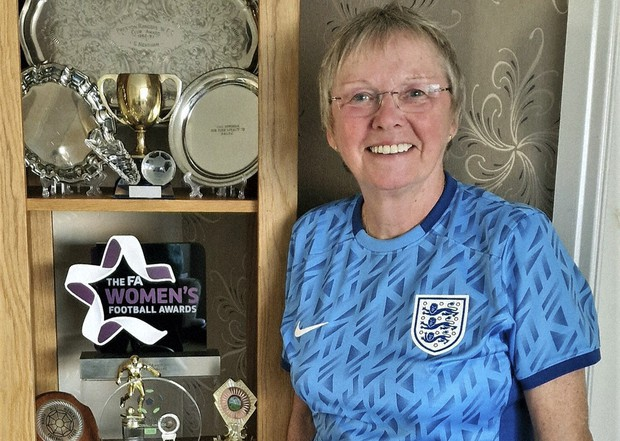
Gail Newsham is a former footballer, author, public speaker, and one of the leading historians of the women’s game in England. She is best known for her lifelong dedication to uncovering and preserving the story of the Dick, Kerr Ladies Football Club, widely regarded as one of the most important teams in the history of women’s football. Her work has played a central role in bringing national and international attention to a team that had long been overlooked by mainstream football history.
Born and raised in Preston, just minutes from the Dick, Kerr & Co. factory where the team was originally formed during the First World War, Gail was always aware of their name but not their full story. In 1992, she organized the first-ever reunion of surviving Dick, Kerr Ladies players, an event that sparked a two-year research journey involving in-depth interviews, archival discoveries, and oral histories with former players. Many of the women she spoke to had played before the Football Association’s 1921 ban on women’s football, giving Gail the rare opportunity to document their stories firsthand. The result was her groundbreaking book In a League of Their Own!, first published in 1994, which remains a cornerstone text on the history of the women’s game.
Gail’s efforts have led to several landmark moments in women’s football history. Her advocacy contributed directly to Lily Parr becoming the first female player inducted into the National Football Museum Hall of Fame in 2002. She also played a key role in gaining formal recognition for the Dick, Kerr Ladies, including a Special Recognition Award from The Football Association in 2017 and commendations from the Royal British Legion and the North West Football Awards in 2018.
Before turning to writing and research, Gail had a nearly twenty-year playing career in women’s football, starting in the early 1970s. She played for Preston Rangers WFC, reaching two Women’s FA Cup semi-finals and winning titles in the North West Women’s Football League. Off the pitch, she served on the League Management Committee and worked to promote the women’s game both locally and internationally. In 1986, she established The Lancashire Trophy, an international women’s tournament that attracted clubs from Sweden, Germany, Austria, Switzerland, and beyond. It was at this event in 1992 that the Dick, Kerr Ladies were reunited for the first time in four decades.
Over the past thirty years, Gail has become a respected public speaker, invited to lecture at universities such as Cambridge, Manchester, and UCLan, and at events organized by the NHS, the National Football Museum, and women’s organisations across the UK. Her talks are consistently praised for their passion, depth, humor, and emotional resonance. In 2019, she was awarded an Honorary Fellowship by the University of Central Lancashire in recognition of her outstanding contribution to sport and history.
Today, Gail continues to advocate for the recognition of women’s football pioneers, ensuring that the legacy of the Dick, Kerr Ladies and their role in shaping the game is not forgotten. Her website and revised edition of In a League of Their Own! remain key resources for those interested in learning about one of the most compelling stories in football history.
Our Exclusive Interview with Gail Newsham
What first inspired you to research and document the story of the Dick, Kerr Ladies, and how did that journey begin in 1992?
I was always aware there was a ladies football team in my home town of Preston, but thought how strange it was because when I was growing up, girls were not allowed to play football. I wasn’t aware there had been a ban on women playing, it was just how it was back then and you just accepted the situation while still feeling it wasn’t fair. A chance meeting with former player Brenda Eastwood in 1991, gave me the idea of organising a reunion of the team to take place at our football tournament, The Lancashire Trophy, in 1992. An appeal in the local paper was successful and I initially managed to locate seventeen former players to come to the reunion, and that is all it was meant to be. But, the first lady I went to see after the article in the press, showed me a team picture from 1952, it was taken in a field, just outside Preston, and I couldn’t believe how many people were on the touchline. When I was playing, no one came to watch us, it was just members of our team and a few friends, and it blew me away, I couldn’t understand how they could attract so many people to their matches. The next lady I visited, showed me some newspaper clippings from the Daily Herald of 1946, and I couldn’t believe how much media coverage they had. It became obvious to me then, that this was a much bigger story than anyone realised, and if something hadn’t have been done, their history could have been lost forever. So I spent the next couple of years researching their unique story, travelling all over the North West of England, meeting former players and family members of players who were no longer with us, and managed to piece together their incredible story.
As someone who spoke directly with players from the pre-FA ban era, what were the most powerful or surprising stories you uncovered during your research?
Meeting ladies who played before the ban was indeed a great privilege, I feel very lucky to have met them and hear their stories first hand. Alice Norris was eighty nine when I met her, she was as bright as a button and shared many stories with me, in fact it was her Mum who took in Lily Parr when she first came to Preston to play for the team, and this is where these stories originated. Alice was thrilled that a book was being written about her team, and she should have come to my book launch in 1994, but she was taken ill. However, her daughter read her an extract of the book when she visited her every day in hospital. Sadly, Alice passed away on Boxing Day (26 December), but not until her daughter had read her the last chapter, so she got to hear it all before she left. There are so many stories I uncovered during all my research but one that I think is probably one of the most powerful, is one shared by Alice. She told me of the team taking part in The Blackpool Carnival in 1923. The factory had prepared a float for the Dick, Kerr Ladies to be part of a huge procession. Alice said that at one point, as they were parading along the route through the town, the Ex Servicemen’s float stopped opposite their float and they stood up and saluted them. The team had dedicated all their fund raising efforts to the Ex Servicemen’s Appeals after WW1 and there is no doubt they raised an enormous amount for them, and this was their way of saying a special thank you. It was seventy years after the event when Alice told me this story, but she still remembered with immense pride that very special moment in her life.
How did your own experience as a footballer influence your connection to the history of the women who came before you?
I grew up in the same area as many of the Dick, Kerr Ladies, just a stone’s throw from the factory where they worked during the War, and the early 1920s. I have walked in their footsteps and I genuinely feel a connection with them. When I discovered the injustice of what had happened to them, and that for so long they had been forgotten, I wanted to tell their story so that they could have the recognition they deserved and bring them back to life. I knew how important football was to me, and I can’t begin to imagine how I would have felt if we had had our light snuffed out as ruthlessly as they had. For so long, they were football’s best kept secret and they deserved to have their place in the record books.
In what ways do you think the legacy of the Dick, Kerr Ladies continues to shape the women’s game today, both in the UK and internationally?
The vast majority of people are still unware of the FA Ban in 1921, and when they hear of this injustice, it’s a jaw dropping moment as it becomes apparent that women’s football was banned for fifty years. Hearing of their glittering success in the years before the ban, the size of crowds they were attracting makes it all the more unbelievable that the FA could inflict such a devastating blow, but their refusal to give up no matter what the establishment threw at them, makes them stand out above all others. There is no one else like them and thankfully, their history is now being celebrated.
You have been a tireless advocate for recognition and commemoration of these pioneers. What moment of recognition or tribute has meant the most to you personally?
Their Centenary year was in 2017, and I think having the first Blue Plaque in the world for women’s football, placed on the factory wall where they were formed in 1917, ranks pretty high on the list. The memorial tribute at Preston North End I think was another first for women’s football in this country, and the first ever National Women’s Walking Football Tournament, The Dick, Kerr Ladies Cup, is another way of keeping their name alive and continuing the legacy. The recognition from the FA for their Contribution to Football, and the North West Football Awards gave another special recognition award in 2018, when they were described as ‘probably the most important team in the history of women’s football’, was another special moment. Considering that when my book was first published in 1994, no one really knew who they were, for them to receive an accolade like that, just fills my heart with joy.
Looking ahead, what are your hopes for the future of women’s football history and how it is remembered and taught to new generations?
My hopes for the future of women’s football history is that people just tell it like it is and keep its authenticity. Back everything up with facts and evidence without making things up to make it something it’s not. There is so much incorrect information on Wikipedia, particularly about Dick, Kerr Ladies, and especially Lily Parr, it takes my breath away. I also think that perhaps academics tend to put a 21st century take on life back then, and it’s not necessarily a true reflection of how it really was.